Yes. Not always, not overnight, not with every product on the shelf — but the conditions that cause decay are easy to create by accident, and a soft covering creates most of them at once. The honest answer has little to do with the fabric and everything to do with what the fabric stops from happening.
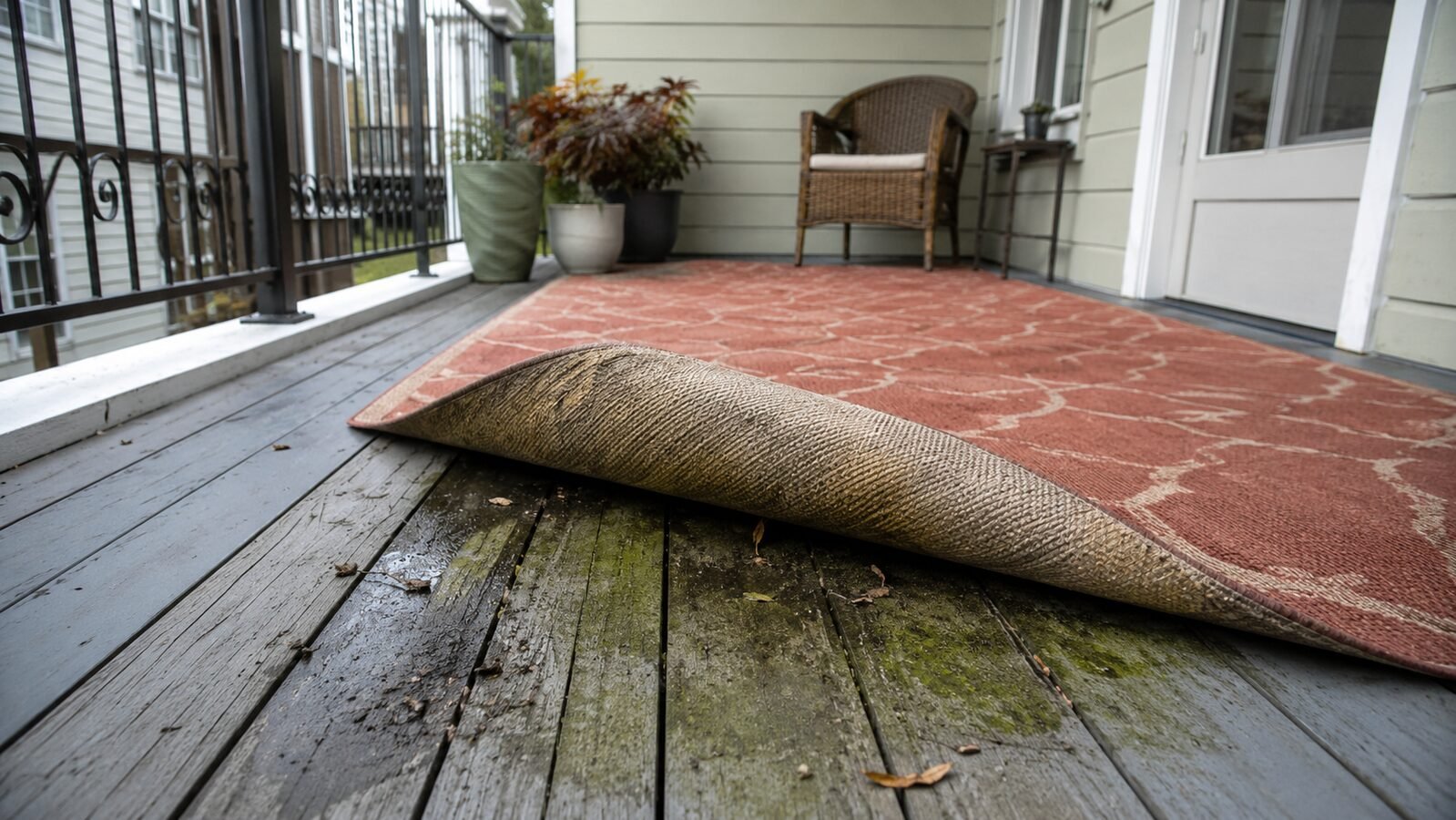
Lumber outside gets wet constantly. Rain, fog, irrigation overspray, morning dew across the Sacramento Valley for half the year. None of that causes decay by itself, because wet timber that dries is simply wet timber. The real question behind every outdoor rug on deck planks is not whether water arrives but whether it leaves. What follows covers the moisture threshold that matters, what a covering does to it, which materials behave, and what shows on a meter when somebody finally lifts the thing.
The Four Conditions Decay Actually Requires
Wood does not rot because it is wet. It rots because fungi eat it, and those fungi need four things at once: cellulose, oxygen, temperature between roughly 40 and 105 degrees Fahrenheit, and water. Remove one and nothing happens. Three are permanently present on any exterior structure in California, leaving exactly one variable anybody controls.
That variable is moisture content. Below about 20 percent, decay fungi cannot establish, however many spores land there. Sustained readings above it make the wood hospitable, and past 30 percent — fiber saturation — serious decay proceeds. This is why 20 percent is written into inspection practice: a reading at or above gets flagged even when nothing visible has gone wrong.
Air-dried timber sits under that line. A pressure-treated board soaked in a January storm and dry two days later never spends enough time above threshold to matter. Drying potential, not wetting, keeps a structure sound — which is why an outdoor carpet on wood deck surfaces behaves differently from the same fabric indoors.
What a Covering Does to the Drying Half
Now remove the second half. Moisture still arrives under any outdoor rug on deck framing — through the weave, in at the edges, condensing underneath on cool mornings. What changes is the exit. Evaporation that normally takes hours now takes days, and in shaded corners may not finish before the next storm.
The effect of an outdoor rug on deck boards is not that it adds water. It converts occasional wetting into sustained wetting, and sustained is the word in every definition of decay conditions. A board that spent six hours above 20 percent now spends six days.
Sacramento’s climate makes this worse both ways. Winter saturation supplies the water; summer heat parks the boards in the 70-to-90-degree band where decay fungi are most active. A deck with outdoor carpet left down through both seasons runs the full cycle twice a year.
On a private lot that is a maintenance question. On rental property it is not: SB 721 makes the condition of an exterior elevated element a written finding rather than an owner’s judgment call. Nobody writing that report can assess outdoor rugs on wood decks without lifting them first.
Backing Material Decides Almost Everything
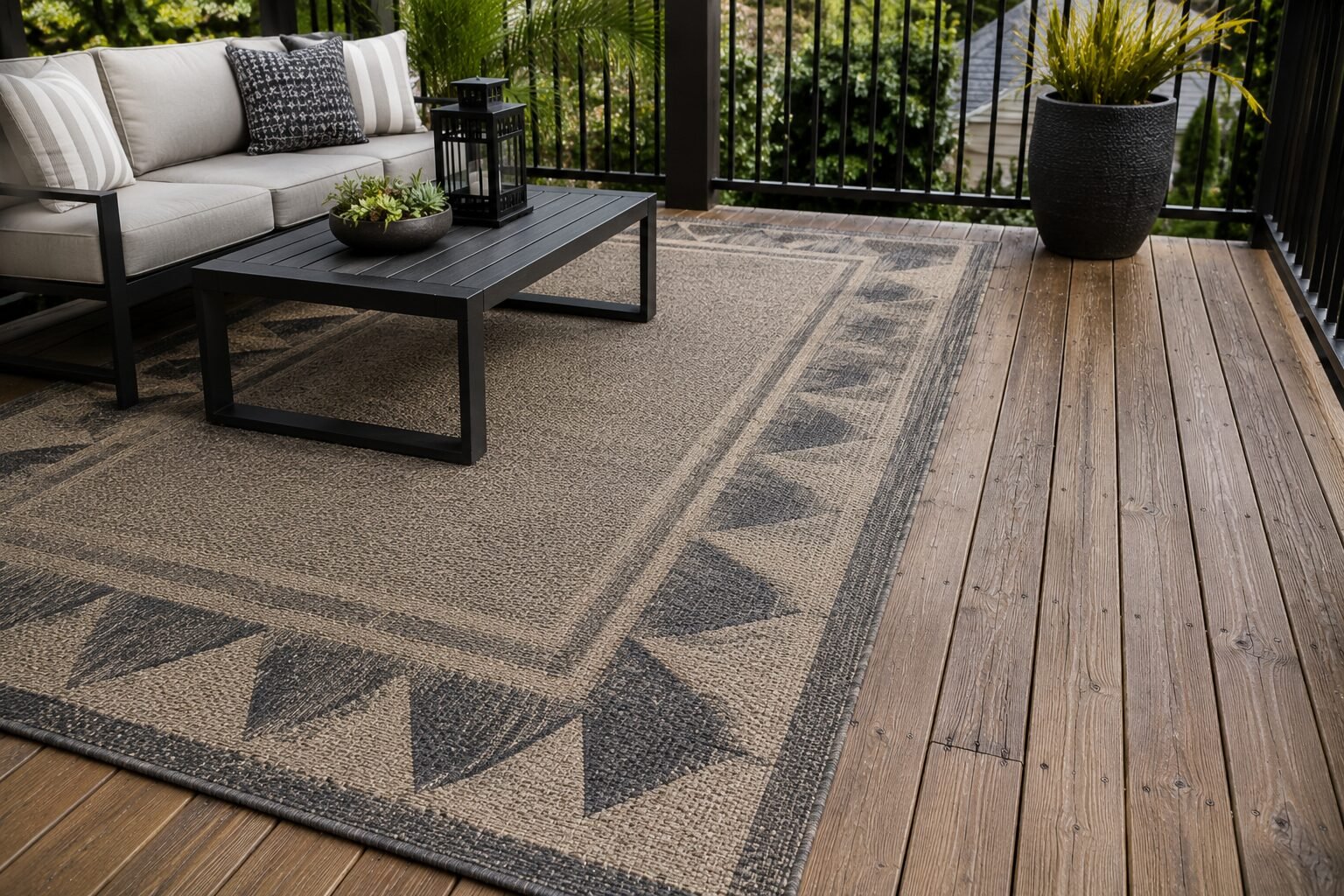
Not every product behaves alike, and the difference sits in what touches the timber rather than what your feet touch. Comparing outdoor rugs for wooden decks by pattern or price misses the only variable that matters. The list runs worst to safest.
- Solid rubber or latex backing. The worst option available: an impermeable membrane laid directly on lumber, holding water against the surface indefinitely. Composite manufacturers warn against it explicitly.
- Solid vinyl or PVC sheet backing. Same mechanism, same result. Anything that keeps a floor dry underneath does the wrong job outside.
- Natural fibers. Jute, sisal, cotton, and wool absorb heavily and release slowly. After rain a jute mat acts like a sponge held against the wood for a week.
- Foam or felt pads. Non-perforated pads sold for interior use trap and hold. If it is not drilled or open mesh, keep it indoors.
- Flat-woven polypropylene or olefin, no backing. Moisture passes through, air moves underneath. A woven outdoor rug on wood deck planks is the least damaging option in common use.
- Open PVC mesh. Drains fastest, sheds moisture quickest, circulates air. Least attractive, most forgiving.
Metal grommets deserve a warning regardless of the fabric above. They corrode, and rust runs into the grain, leaving stains no cleaning removes because the discoloration sits inside the wood rather than on it.
What Collects Underneath
Moisture is half the problem. The gap between fabric and timber becomes a debris trap: pollen, leaf fragments, soil off planters, pet hair. Organic matter holds water long after the surrounding surface dried, and feeds the same fungi. Covered lumber and bare planks differ by drying rate, and debris widens the gap.
Grit does mechanical damage on top of that. Sand caught under a mat grinds against the finish every time somebody crosses it or wind shifts an edge. Once the sealer wears through, bare timber absorbs water faster than the protected surface beside it, and an outdoor carpet on wooden deck accelerates the process it started.
Composite and PVC Boards Are Not Exempt
A deck with outdoor carpet on synthetic planks fails differently. Composite will not rot the way sawn timber does, but it is not indifferent. Trapped moisture produces mold and mildew staining, and rubber or latex backing leaves residue on capped material that resists removal. Trex, TimberTech, and Deckorators all publish guidance on this, and none of it says put anything down and forget it.
Two details specific to synthetic boards are worth knowing. New material weathers to its final shade over the first months, so a covering laid too early prints its outline permanently. And what is safe on synthetic material is defined by backing rather than fiber — the same rubber layer that traps water on timber traps it here too, producing staining instead of decay.
What an Inspector Finds Underneath
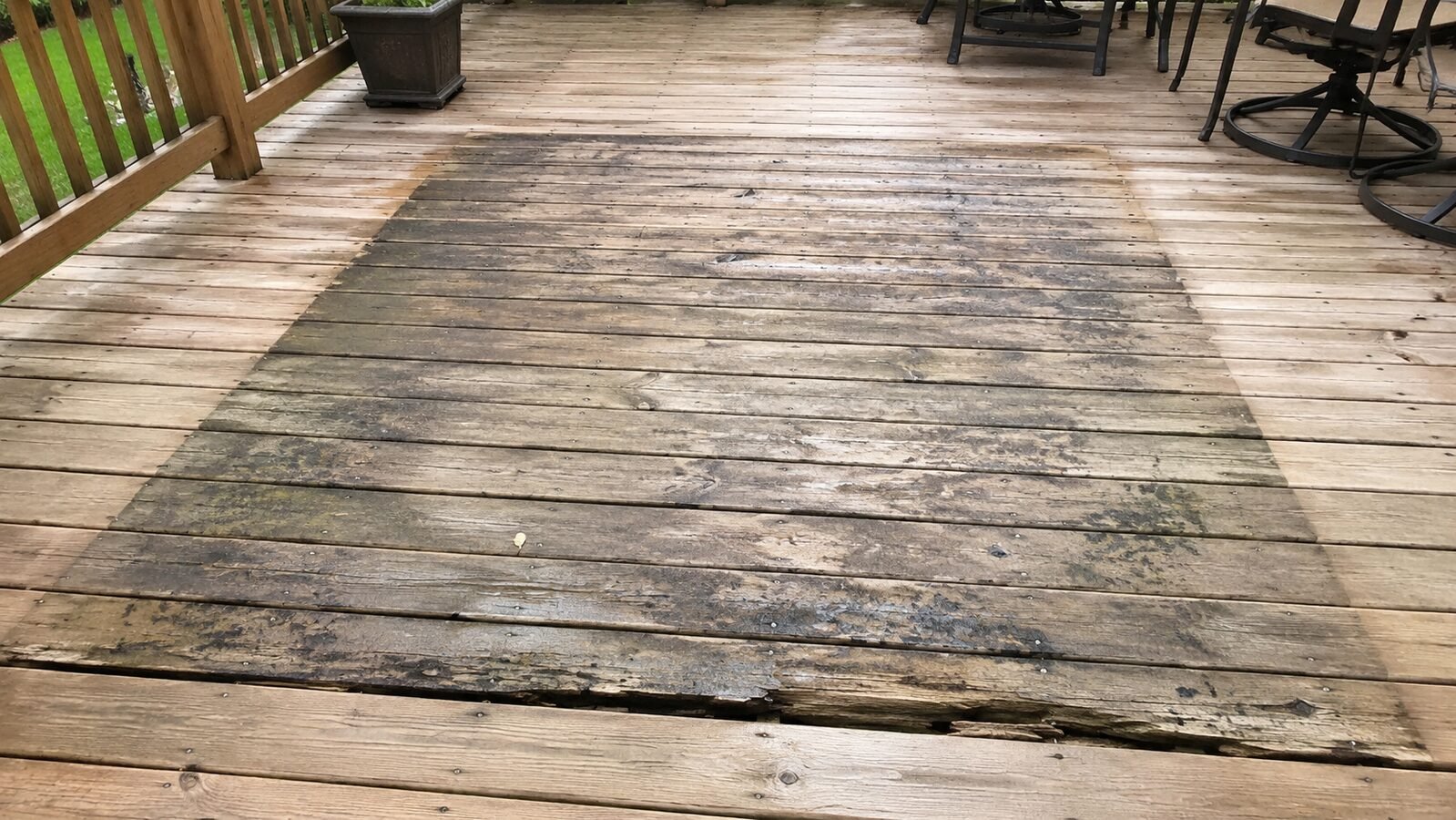
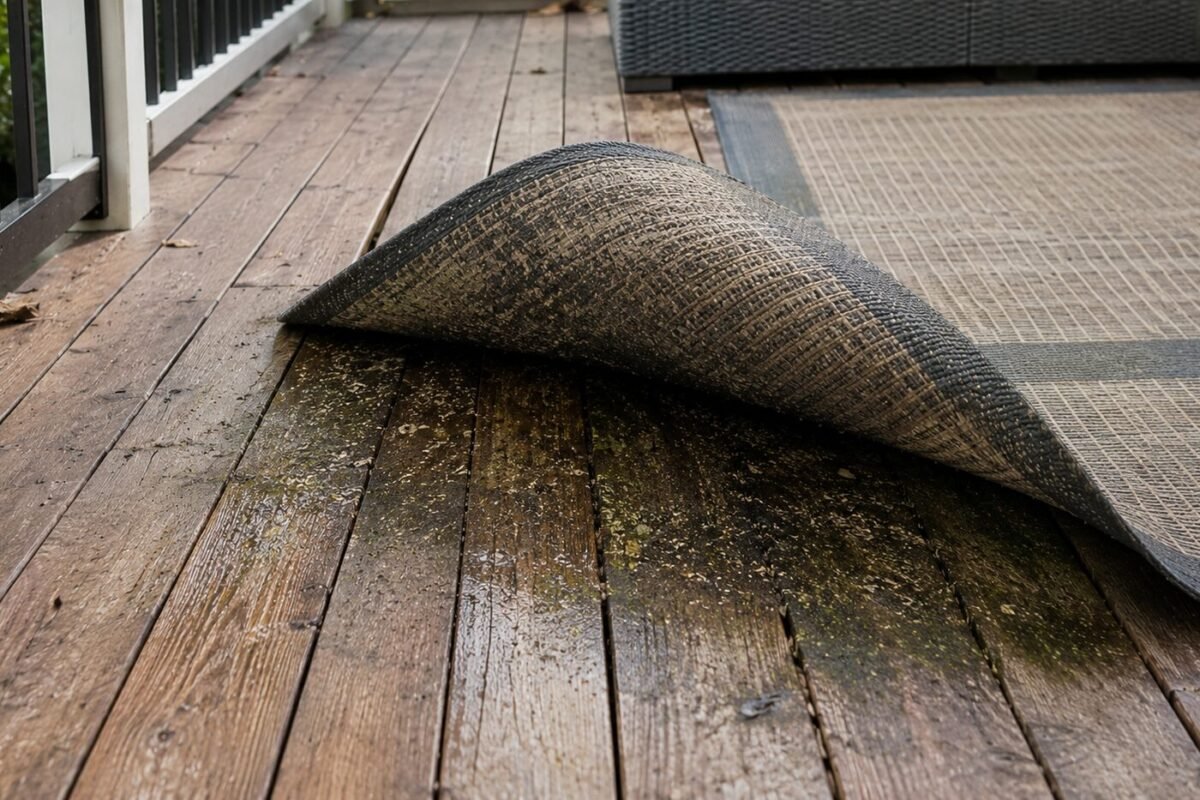
Lift a covering down two seasons and the pattern is unmistakable. Its outline prints on the boards in darker wood, sharp at the edges. A meter reading 12 percent on the exposed surface two feet away reads 22 or 25 underneath. Mildew shows as black speckling in the grain, and boards cup because the covered face swelled while the exposed face did not.
Probe with a screwdriver and the difference turns structural. Fastener heads sit in timber damp for years, and screws corrode from inside where the shank meets wet fiber. Soft spots cluster where water sat longest: along seams, at the low edge, anywhere the fabric bunched. This is why an outdoor rug on wooden deck surfaces gets treated as a condition to investigate rather than a furnishing to note.
None of that is visible while the covering is down, which is what matters for anyone with a report coming. Diagnosing a deck with outdoor carpet on it starts with removing the carpet, because everything a report must record sits on the surface underneath. Inside San Francisco, Section 604 removes even the argument, calling for every element to be examined rather than a sample.
Six Rules That Keep It From Becoming a Finding
The answer is not always no. It depends on choices that are easy to get right and just as easy to get wrong. Follow the sequence below and the risk drops to something most owners accept.
- Buy for the backing, not the pattern. Flat-woven synthetic, no solid layer underneath. If you cannot see daylight through it held to the sun, water will not pass either.
- Lift it after every soaking. The habit that prevents almost everything else, and the reason outdoor rugs for wood decks are survivable at all. Lumber drying within a day never reaches threshold, whatever lies on it.
- Move it every few weeks. Rotating prevents both permanent shadow lines and the concentrated wetting a fixed footprint produces.
- Sweep underneath at the same time. Removing debris removes the reservoir. Two minutes, and it eliminates the slowest-drying material on the structure.
- Take it up for the wet season. From late October through March here, evaporation windows are short enough that no fabric is worth the risk.
- Check the boards before it goes back. A pin meter costs less than one plank. Anything over 20 percent stays uncovered until it comes down.
Followed consistently, those six turn the question from structural into cosmetic. Ignored, they produce exactly the finding described earlier, and the repair gets measured in replaced planks rather than in cleaning. The outdoor rug wood deck owners come to regret is always the one nobody has lifted since the day it went down.
One more consideration applies across the Sierra foothills and anywhere inside a designated fire severity zone. AB 3074 created Zone 0, the ember-resistant band running five feet out from a structure, and it expressly includes attached platforms and the space beneath. State guidance tells owners to limit combustible items sitting on those surfaces, and a synthetic mat is exactly such an item. Requirements phase in through the second half of this decade on a schedule that differs locally, so confirm before treating a covering as purely a moisture question. Owners asking whether outdoor carpet for wood decks is a mistake usually mean rot; in El Dorado or Placer County the answer has a second half.
Multifamily Property: A Covering the Law Will Not Let You Leave Down
Private homeowners choose their own risk. Owners of income property do not, because the walking surface of an exterior elevated element is what the statutes require somebody to look at. Health and Safety Code Section 17973 obliges buildings holding three or more dwelling units to have those elements evaluated by a licensed professional, and AB 2579 reset the opening deadline to the first day of 2026 on a sixth-year cycle. A fixed covering across a balcony floor obstructs that evaluation, and obstruction excuses nothing.
Community associations answer to SB 326 on a nine-year cycle opened at the start of 2025, with the work reserved to architects and engineers. Neither statute exempts furnishings, and neither treats a covered floor as inspected. Managers allowing indoor outdoor carpet on decks across a property should expect removal to become a line item on inspection day.
If It Has Already Been Down Two Years
Discovering the problem late is not discovering it too late. Decay halts once the wood falls below threshold, and existing damage stays put rather than spreading into sound material. What matters is how far it went before you looked.
Any deck with outdoor carpet down two seasons deserves this sequence first. Take everything up and leave the surface open for a clear week, then work across it methodically. Probe every board with a screwdriver, watching seams and the area around fasteners. Meter in several places and compare covered areas against exposed. Look underneath at the joists, because water passing between boards landed on framing that never saw sun. Where a screwdriver sinks more than an eighth of an inch, you are past cleaning.
That last check is the one homeowners skip and the one ABD Inspections starts with, because staining is cosmetic while soft framing is structural. The two look nothing alike on a report, and cost nothing alike to fix.
The Verdict, Plainly Stated
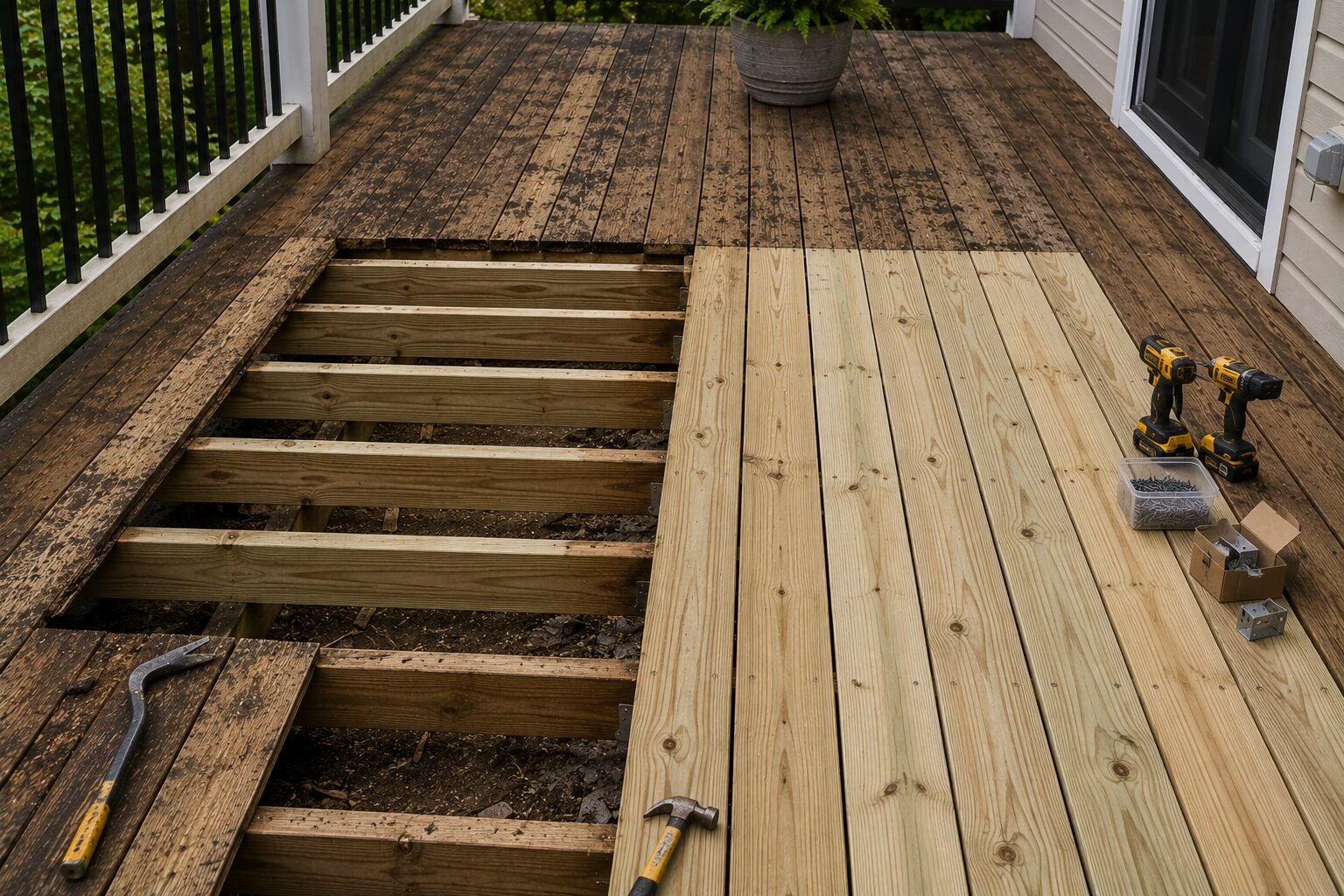
Will an outdoor rug on deck planks destroy them? On its own, in one summer, no. Left down year-round on softwood in a climate with a real wet season, over several years, very possibly — and the damage gets found by somebody probing the framing, not by anybody looking at the surface. The same holds for outdoor rugs on wooden decks of any species, cedar and redwood included.
The reasonable position sits between the extremes. Use flat-woven synthetic, lift it when it rains, take it up for winter, check underneath twice a year. Do that and the risk drops close to nothing. Skip it and you have built a moisture chamber on top of the one component that has to stay dry to keep doing its job.