Structural Repair
- Joist, beam, and rim replacement
- Ledger board reinforcement and re-flashing
- Connection hardware upgrades
- Support post and deck footing reconstruction
Alameda County · SB 721 & SB 326 specialists
Berkeley has its own balcony inspection program, the Exterior Elevated Elements Inspection Program (E3), which follows the SB 721 and SB 326 cycles and adds City filing requirements. We carry out E3, SB 721, and SB 326 balcony inspections for apartment owners, condo associations, and property managers in every part of Berkeley, from the apartment buildings around campus on Southside and Northside to the newer mid-rises in Downtown Berkeley and along University, Shattuck, and San Pablo Avenues, and the hillside decks of the Berkeley Hills. We submit the Inspection Certification to the City for you and handle any repairs the inspection calls for.
Inspection, compliance, repair, and reconstruction for Berkeley apartment owners, HOA boards, and property managers — handled end‑to‑end by one licensed team.
What type of property do you manage?
Which exterior structures are 6 feet or more above ground?
Select all that apply
Get your free compliance assessment
We'll send your personalized report within 24 hours
Thank you! We'll contact you within 24 hours with your personalized compliance report.
Wood-framed balconies are the main subject of the E3 program, and the 2015 collapse that started it involved wood balcony joists decayed by water. In Berkeley, many of these balconies have a closed soffit underneath, so the joists cannot be seen from below. For rental buildings, the City's E3 guidelines require investigative openings at no less than 15% of soffit locations, placed where water is most likely to enter: where the deck meets the wall, at guardrail post penetrations, and at floor drains. We cut these openings, check the wood for decay and moisture, and patch them to match the existing finish.
Reinforced concrete balconies are exempt from E3, just as they are not covered by SB 721 or SB 326. Steel is a different matter in Berkeley. The state laws cover elements supported by wood, but the City's program also covers steel-framed balconies, stairs, landings, and walkways. On older apartment buildings near campus and on mid-rises downtown, we inspect steel framing and its connections for corrosion and loss of section, and we include steel elements in the sample when the City requires them. Fire escapes are excluded from E3, because the Fire Department inspects them every year.
Composite boards appear on rebuilt decks in North Berkeley, Elmwood, and the Berkeley Hills, and on walkways where older wood decking has been replaced. The boards themselves resist rot, but they do not change what is underneath: the joists, ledger, and flashing at the wall are often original. As part of every deck inspection, we lift boards where the deck meets the building and at the outer edge to check that framing.
A 30-minute on-site walkthrough tells you exactly what's required.
California's balcony inspection laws trace back to Berkeley. On June 16, 2015, a fourth-floor balcony at the Library Gardens apartments on Kittredge Street collapsed, killing six people and injuring seven. The joists had decayed from water intrusion. About a month later, the City passed an emergency ordinance requiring inspection of balconies and decks on apartment buildings, and early inspections found that 402 of 2,176 structures needed corrective work. Today's E3 program sets a 6-year cycle for apartment buildings and a 9-year cycle for condominiums, and every inspection ends with a certification filed with the City.
Berkeley had 124,321 residents at the 2020 Census, and more than half of its homes are rented. Before the early 1970s, large apartment buildings replaced older houses near the university and downtown to house a growing student population. The Neighborhood Protection Ordinance of 1973 and the Landmarks Preservation Ordinance of 1974 then brought most new construction to a stop, until a new wave of downtown apartment building began in 1998. As a result, most E3 work in Berkeley falls into two groups: apartment buildings from before 1973 around campus, and mid-rise buildings built since 1998 downtown and along the main avenues. Wood decks in the Berkeley Hills, near the Hayward Fault, form a third group with their own concerns.
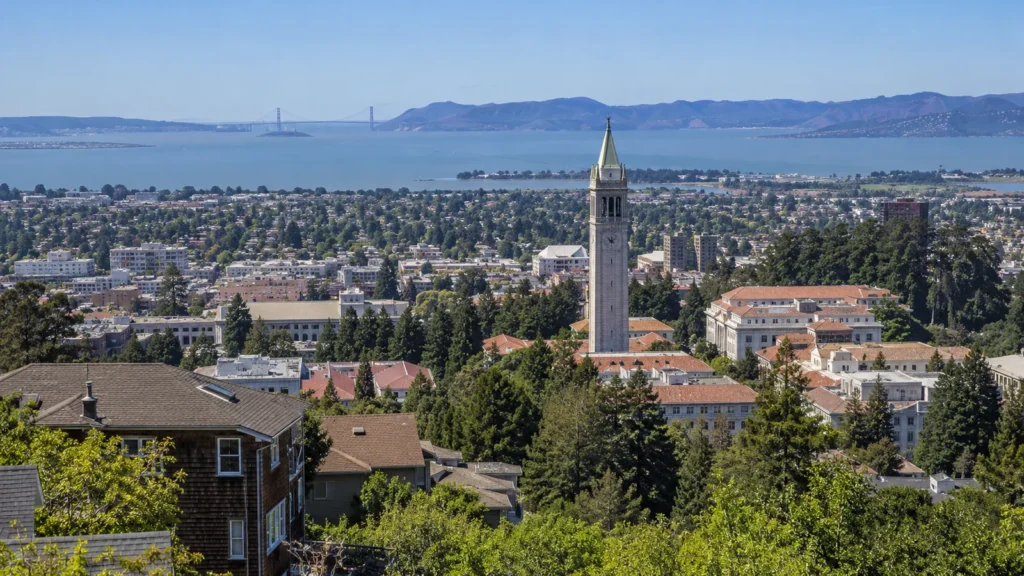
Berkeley receives about 25 inches of rain a year on 64 to 67 rainy days, with January highs near 59°F and September highs near 76°F. That is about twice the rainfall of inland Delta cities such as Antioch, and it arrives during cool months when evaporation is low. Water that gets past a door threshold or a guardrail post into an enclosed soffit can stay there through the winter. This is why the E3 guidelines focus on concealed framing and why our inspections here rely on opened soffits and moisture readings rather than on the look of the surface.
Issues that repeat across the local building stock — from climate, construction era, or common materials in this area.
Balconies with a finished ceiling underneath hide their joists completely. Water enters at the wall line or around a guardrail post and stays in the closed space, often with little or no ventilation. Decay found this way requires a Tier 2 evaluation under the E3 guidelines. When ventilation is added during the repair, the new vents need a permit, and we include that in the repair scope.
Steel stairs, landings, and balcony frames on older buildings rust first at welds, bolted connections, and where steel posts meet concrete or wood. Paint can hide section loss until it is advanced. Because steel elements are in scope under E3, we clean and inspect these connections and measure remaining material where corrosion is visible.
Decks in the Berkeley Hills often stand on long posts over steep ground, with the ledger carrying a large share of the load. Ledger flashing, post-to-beam connections, lateral bracing, and footings on the slope are the critical points. On hillside multifamily buildings our deck inspection checks each of these points and records them in the report.
On pre-1973 apartment buildings around campus, units open onto exterior walkways and balconies with low door thresholds. Over decades, membranes and flashings at these doors fail, and water runs under the walkway surface toward the framing. We flood-test or probe these locations when the surface condition suggests a leak.
The E3 process does not end with the first certification. When an inspection finds problems, the owner must apply for a building permit within 120 days of filing, complete the work within 120 days of permit approval, and then submit a new Inspection Certification after a second inspection. Buildings often have the repair done but the final filing missing. We track these dates and file the closing certification ourselves.
Berkeley rental buildings with three or more units follow the E3 6-year cycle, which started with the first inspection deadline on March 31, 2022. We inspect at least 15% of each type of element, open soffits as the guidelines require, and file the certification through the City's online portal. This applies to buildings across Southside, Northside, Downtown, and the avenues.
Condo associations with three or more units follow a 9-year cycle under SB 326 and E3. The City extended the first condo certification deadline to August 1, 2026. Under the guidelines, a random list of element locations must be generated before the first site visit, and the sample must reach 95% confidence with a margin of error of no more than ±5%. A licensed engineer or architect signs the report.
HOA boards receive an HOA balcony inspection report with findings listed per building and per element, a repair scope with line-item pricing, and the completed E3 forms for condominiums, ready for board review, reserve planning, insurance, and lender requests.
E3 also covers buildings with three or more sleeping units, so it reaches student co-ops, rooming houses, dormitory-style buildings, and some assisted living facilities, along with fourplexes, mixed-use buildings, and small apartment buildings in North, South, and West Berkeley.
Serving all of Berkeley with fast response times. Most assessments within 3 business days.
After the work is complete, you walk away with a full archive package — ready for your HOA board, insurer, city, or next property sale.
Before, during, and after photos tagged to every structural element inspected.
Full permit package, inspection card sign-offs, and city correspondence archived.
Manufacturer warranties plus our labor guarantee in writing.
Detailed scope-of-work summary covering every repair and reinforcement.
Engineer-signed SB 721 / SB 326 letter for your HOA archive, insurance, and lender.
For Berkeley properties, the package also includes copies of every E3 form submitted to the City: the Inspection Certification, the second certification after corrective work, or the Exemption Declaration for buildings without covered elements. A map of investigative opening locations is included so the next inspection can return to the same points.
We walk the property, identify scope, and flag any urgent safety items. No cost, no obligation.
Full proposal with line-item pricing, material specs, and a realistic timeline.
We handle city permits and coordinate tenant notices with property management.
One licensed crew, start to finish. Daily photo updates and clean worksites.
City sign-off, warranty package, and compliance letter delivered to you.
Our building on Southside has closed soffits under every balcony. ABD opened them where the E3 guidelines call for it, found two balconies with wet joists at the wall, and had the repair permit filed well inside the 120 days. The second certification went to the City with the rest of the paperwork.
We have a downtown building with steel stairs and wood balconies, and we were not sure which parts fell under E3. ABD laid out what was in scope and what was not before the inspection started, so the report matched what the City expected.
E3 uses the same cycles as the state laws: 6 years for apartment buildings and 9 years for condominiums. It differs in three ways. It covers steel-framed elements as well as wood, it includes buildings with three or more sleeping units, and it requires the owner to file an Inspection Certification with the City after each inspection. Because E3 is built on the state requirements, we plan one inspection to satisfy both.
The inspector files the Inspection Certification with the findings. The owner then has 120 days to apply for a building permit and 120 days from permit approval to complete the corrective work. After the work, a second inspection is done and a new Inspection Certification is filed. We handle the permit, the repair, the second inspection, and both filings as one project.
Usually, yes, if the balconies have closed soffits. For rental buildings, the E3 guidelines require investigative openings at no less than 15% of soffit locations, and sometimes interior finishes need to be opened as well. These investigative openings do not need a permit, and we patch them to match the existing surface. Adding new vents or access panels does need a permit, so we include those in the repair scope if they are recommended.
In the wrong city? Jump to the right page for your property.
Tell us about your property and we'll come out, walk it, and give you a written plan — free of charge, no obligation.