Structural Repair
- Joist, beam, and rim replacement
- Ledger board reinforcement and re-flashing
- Connection hardware upgrades
- Support post and deck footing reconstruction
Contra Costa County · SB 721 & SB 326 specialists
Much of our work in Antioch is on two-story garden apartment complexes, where exterior stairs and second-floor walkways are the elements SB 721 requires owners to inspect. We provide SB 721 inspection, SB 326 inspection, and deck repair for apartment owners, condo and townhome associations, and property managers, from the older buildings near Rivertown and along Sycamore Drive and Delta Fair Boulevard to the newer communities off Lone Tree Way, Deer Valley Road, and Hillcrest Avenue. Each balcony inspection and deck inspection report lists every exterior elevated element in the sample, with its condition, photos, and the repair it needs.
Inspection, compliance, repair, and reconstruction for Antioch apartment owners, HOA boards, and property managers — handled end‑to‑end by one licensed team.
What type of property do you manage?
Which exterior structures are 6 feet or more above ground?
Select all that apply
Get your free compliance assessment
We'll send your personalized report within 24 hours
Thank you! We'll contact you within 24 hours with your personalized compliance report.
The typical Antioch apartment complex is wood-framed, two stories high, with open stairs and a walkway along the second floor. Stair stringers, landings, walkway joists, and the posts that carry them are all wood, and all of them sit in full sun for most of the year. Heat dries the wood out, it shrinks, and bolts and lag screws lose their grip. On these buildings we check fastener tightness at every stair and walkway connection in the sample, not only the surface condition of the boards.
Antioch has few fully concrete balconies. Concrete appears more often as the base under wood elements: stair landings at grade, footings under walkway posts, and slabs at the bottom of exterior stairs. These pieces rest on clay soil that swells when wet and shrinks when dry, so a landing can rise or drop a little each season. We check how the wood stringer meets the concrete, because that is where the movement shows up first as gaps, split stringer ends, or tilted posts.
Composite boards are a common replacement for sun-damaged wood decking on Antioch balconies and walkways. Composite expands and contracts with temperature more than wood does, and July afternoons here average above 90°F. Boards installed without the end gaps the manufacturer specifies can buckle, push against posts, or pull fasteners loose. We check board spacing and fastening along with the framing underneath.
A 30-minute on-site walkthrough tells you exactly what's required.
Antioch grew from 28,060 residents in 1970 to 90,532 in 2000, and to 115,291 by the 2020 Census. Because the population more than tripled in those thirty years, a large share of the city's 36,749 housing units, and most of its apartment complexes, date from the 1970s through the 1990s. About 40% of occupied homes in Antioch are rented. For SB 721 compliance, that means many buildings of the same age and type, with the same wood stairs and walkways, all due for inspection on the same 6-year cycle.
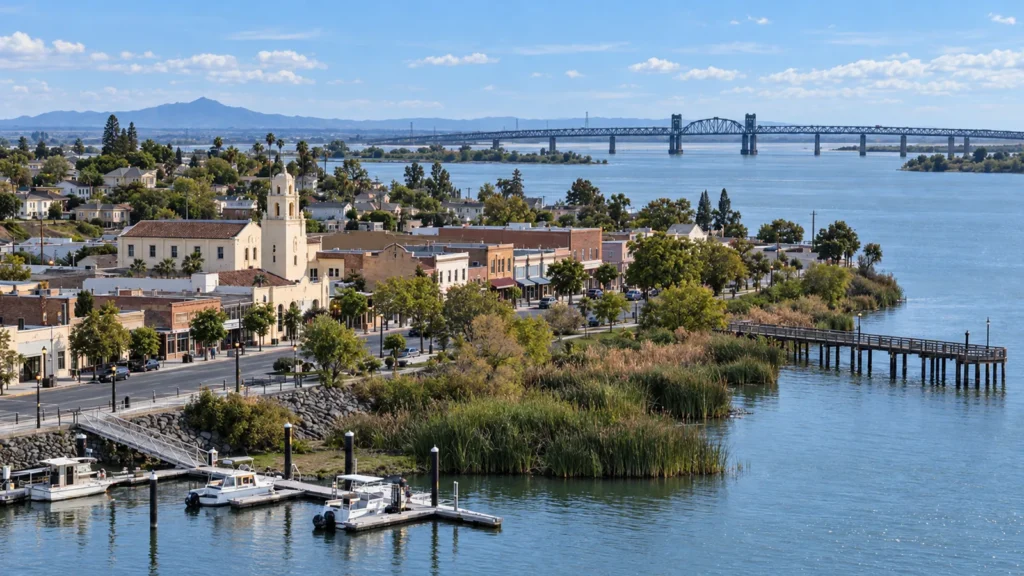
The city sits on the San Joaquin River at the western end of the Sacramento–San Joaquin Delta, with the hills of Black Diamond Mines and Contra Loma regional parks along its southern edge. The climate is semi-arid, with hot, dry summers and mild, wetter winters. The soil under much of the city is clay that changes volume with moisture. Our deck inspection in Antioch is built around those three conditions: sun and heat on the wood, movement at footings and landings, and seasonal water at the base of stairs.
July afternoons in Antioch average 91°F, January afternoons 54°F, and the city gets about 13 inches of rain a year over roughly 55 rainy days. Summer days are hot and nights cool off sharply, so wood, sealant, and membranes expand and contract every day for months. Heat and ultraviolet light, not rain, cause most of the wear on exposed balconies and stairs here. Rain matters mostly at grade, where the clay soil swells in winter and shrinks in summer.
Issues that repeat across the local building stock — from climate, construction era, or common materials in this area.
Stair treads, walkway decking, and guardrail caps on south- and west-facing sides crack along the grain after years of direct sun. Water then gets into the cracks during winter rain. A board can look dry and solid on top and be soft underneath, so we probe treads and decking on these elevations rather than judging them by appearance.
When framing lumber dries and shrinks, the bolts through guardrail posts and stair stringers lose tension. The result is a railing that moves under a push or a stair that shifts underfoot. We load-test guardrails and check stringer connections at each landing, and tightening or replacing hardware is often part of the repair scope.
Concrete landings and post footings on expansive clay rise and settle with the seasons. Over the years this opens gaps between the stringer and the landing, cracks stringer ends, and tilts walkway posts out of plumb. We record level and plumb readings at these points so the next inspection can show whether the movement is continuing.
Antioch's rainfall is low, but many complexes water lawns and planters right next to stair posts and stringer ends. Sprinkler spray keeps the bottom of the wood wet through the summer, and rot starts at grade even on buildings with dry upper framing. We inspect the base of every post and stringer in the sample and note where irrigation needs to be redirected.
Sealant joints at doors and wall terminations, and walkable membranes on second-floor walkways, crack and lose adhesion under repeated daily expansion and contraction. The failures are often small, but they let winter rain into the framing below. We check every threshold and wall termination in the sample for adhesion, not only for visible cracks.
Antioch apartment complexes with three or more units need an SB 721 inspection every 6 years. We work with older garden apartments near Rivertown and along Sycamore Drive, Delta Fair Boulevard, and Somersville Road, and with newer communities in Southeast Antioch. We handle the random sample, written entry notices to tenants through your property manager, and the report, and the same licensed team does any repair that follows.
Condo associations in Antioch inspect every 9 years under SB 326. Civil Code Section 5551 requires a random, statistically significant sample, and the report is signed by a licensed engineer. For associations with many identical buildings, we spread the sample across buildings and elevations so the results represent the whole community.
Antioch townhome and condo HOA boards get an HOA balcony inspection report sorted by building, a line-item repair scope the board can vote on, and a compliance letter for the association's records, reserve study, insurer, and lenders. We also file the repair permits.
Two-story garden apartments, triplexes and fourplexes, townhome complexes, and mixed-use buildings in downtown Antioch.
Serving all of Antioch with fast response times. Most assessments within 3 business days.
After the work is complete, you walk away with a full archive package — ready for your HOA board, insurer, city, or next property sale.
Before, during, and after photos tagged to every structural element inspected.
Full permit package, inspection card sign-offs, and city correspondence archived.
Manufacturer warranties plus our labor guarantee in writing.
Detailed scope-of-work summary covering every repair and reinforcement.
Engineer-signed SB 721 / SB 326 letter for your HOA archive, insurance, and lender.
For Antioch properties, the package also includes level and plumb readings at stair landings and walkway posts, taken on the same points that will be checked in the next SB 721 or SB 326 cycle. This shows whether soil movement under the stairs is stable or getting worse.
We walk the property, identify scope, and flag any urgent safety items. No cost, no obligation.
Full proposal with line-item pricing, material specs, and a realistic timeline.
We handle city permits and coordinate tenant notices with property management.
One licensed crew, start to finish. Daily photo updates and clean worksites.
City sign-off, warranty package, and compliance letter delivered to you.
We manage a 1980s complex off Sycamore Drive with eight exterior stairways. ABD found that most of the guardrail posts had loosened as the wood dried out, and two stair landings had dropped away from the stringers. The repair was done building by building so tenants always had a working stair.
Our association has more than twenty buildings that look the same. ABD explained how they would spread the SB 326 sample across buildings and sides of buildings, and the board could see why the results applied to the whole community.
In most cases, yes. SB 721 covers buildings with three or more units and applies to balconies, decks, stairs, walkways, and landings with a walking surface more than six feet above the ground, when wood or wood-based products carry them. A second-floor walkway or balcony in a typical two-story building is well above six feet, so it is included. Ground-level patios and the lower steps of a stair that stay under six feet are not.
Yes. In a wet climate the main concern is water getting into the framing. In Antioch, sun and heat do most of the damage: wood checks and shrinks, fasteners loosen, and sealants and membranes crack from daily expansion. Our inspection here puts more weight on fastener tightness, guardrail load tests, and the condition of sun-facing surfaces, and it includes the base of each post and stringer, where irrigation and soil movement cause problems.
We do. Repairs that replace structural parts of a balcony, stair, or walkway need a building permit from the City of Antioch. We prepare the submittal, schedule the city inspections during the work, and close the permit out at the end. The permit records go into your project package along with the compliance letter.
In the wrong city? Jump to the right page for your property.
Tell us about your property and we'll come out, walk it, and give you a written plan — free of charge, no obligation.