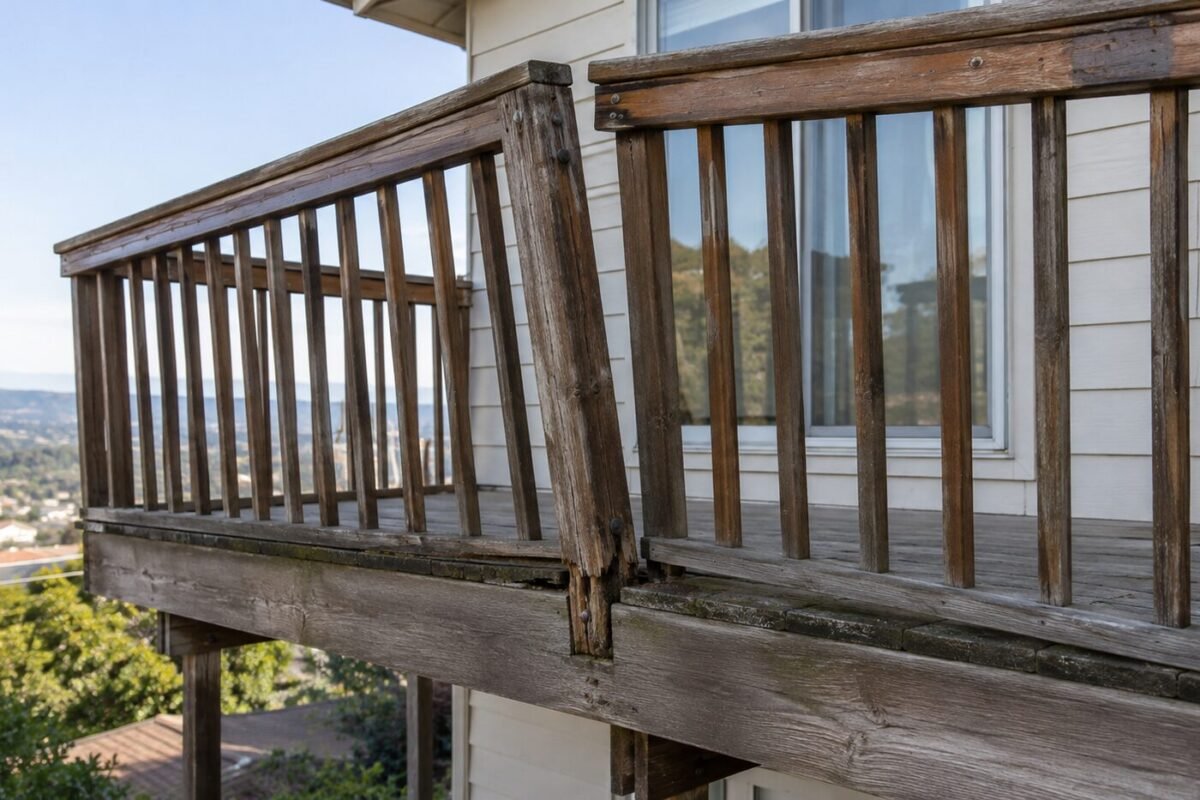
Everybody knows the feeling. You put a hand on the barrier mid-conversation and it gives — a quarter inch, maybe half. Not dramatic. Not enough to spoil the afternoon. So the response is a mental note, a promise to deal with it, and two summers pass.
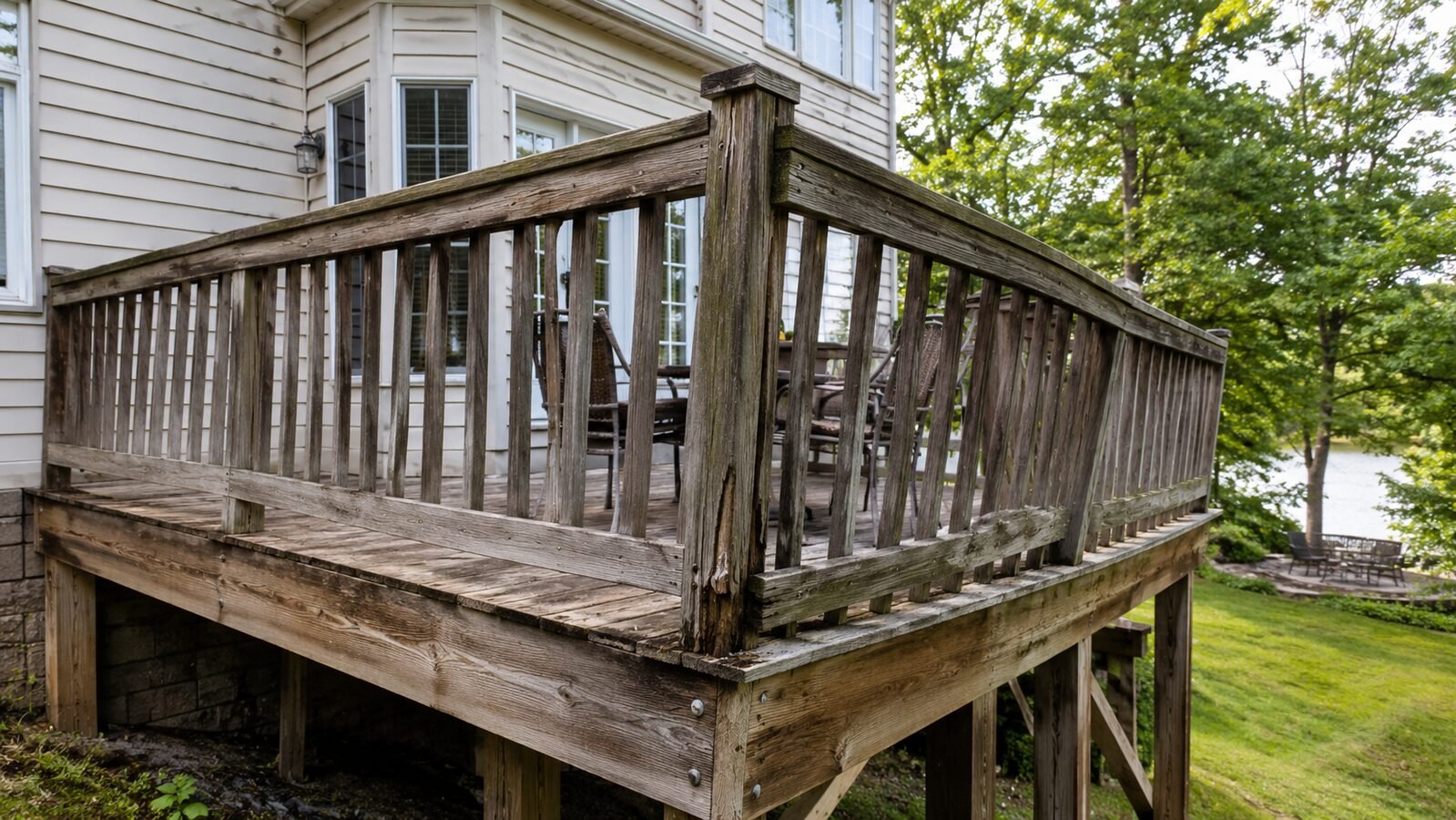
That instinct is understandable and wrong. Play at the top of a guard is not wear. It is the visible end of a connection that gave up out of sight, and the first thing any inspector puts a hand on. What follows covers why these assemblies work free, what testing revealed about the details most were built with, which repairs pass, and when the answer is replacement.
Movement Is a Warning, Not a Nuisance
Table R301.5 of the California Residential Code attaches a number: 200 pounds, concentrated at one spot, any direction, anywhere along the top. Balusters, cable, and panels answer separately to 50 pounds per square foot. Neither describes somebody resting an elbow. Both describe a body arriving sideways.
Measured against that, any deck railing loose enough to shift under a palm has already failed. Nobody leans gently on a barrier and learns it will not hold. They learn at speed. A loose railing four feet above hard ground is a fall waiting for the right afternoon.
Guards sit in Section R321 of the 2025 California Residential Code, effective January 1, 2026, moved from R312. On a single-family lot, ignoring play stays private until somebody sells. On rental property it never does: SB 721 turns the condition of these components into a written finding on a statutory clock, and movement under hand pressure is what gets recorded.
The Leverage Nobody Accounts For
Here is why these joints give way so reliably, and it is arithmetic. Picture an upright standing 44¾ inches above where it is bolted, held by two fasteners about 5¼ inches apart. Push 200 pounds at the top and you generate 8,950 inch-pounds of moment, resisted across those 5¼ inches — near 1,700 pounds of tension on the upper bolt.
Read that twice. A shove at hand height reaches the base multiplied eight times over. Anyone working out how to fix a wobbly deck railing with a socket wrench is fighting a force most never picture. The bolt is not slightly overloaded. It carries most of a ton.
What Laboratory Testing Actually Found
In 2005 researchers at Virginia Tech — Joseph Loferski, Frank Woeste and colleagues — built the joints contractors were using, pulled them apart, and published the numbers. Protocol applies a 2.5 factor to the required load, so the target was 500 pounds at the top of a 4×4 post.
None of the common details reached it. Not the notched upright lag-screwed to the band joist. Not that member through-bolted. Not blocking between joists in the usual arrangements. One version that looked stout, on two half-inch bolts six inches long, averaged 47 percent of what a conforming assembly needs.
Covered structures behave no differently, so how to repair porch railings starts from this data. The failure modes matter most. Specimens let go by screws withdrawing between the band joist and the joists behind, by wood splitting across grain, by heads pulling through, by bending fasteners. Anyone who has had to fix deck railing joints professionally takes one lesson: the trouble is rarely the upright, almost always whatever it is bolted to.
Finding the Real Failure Point
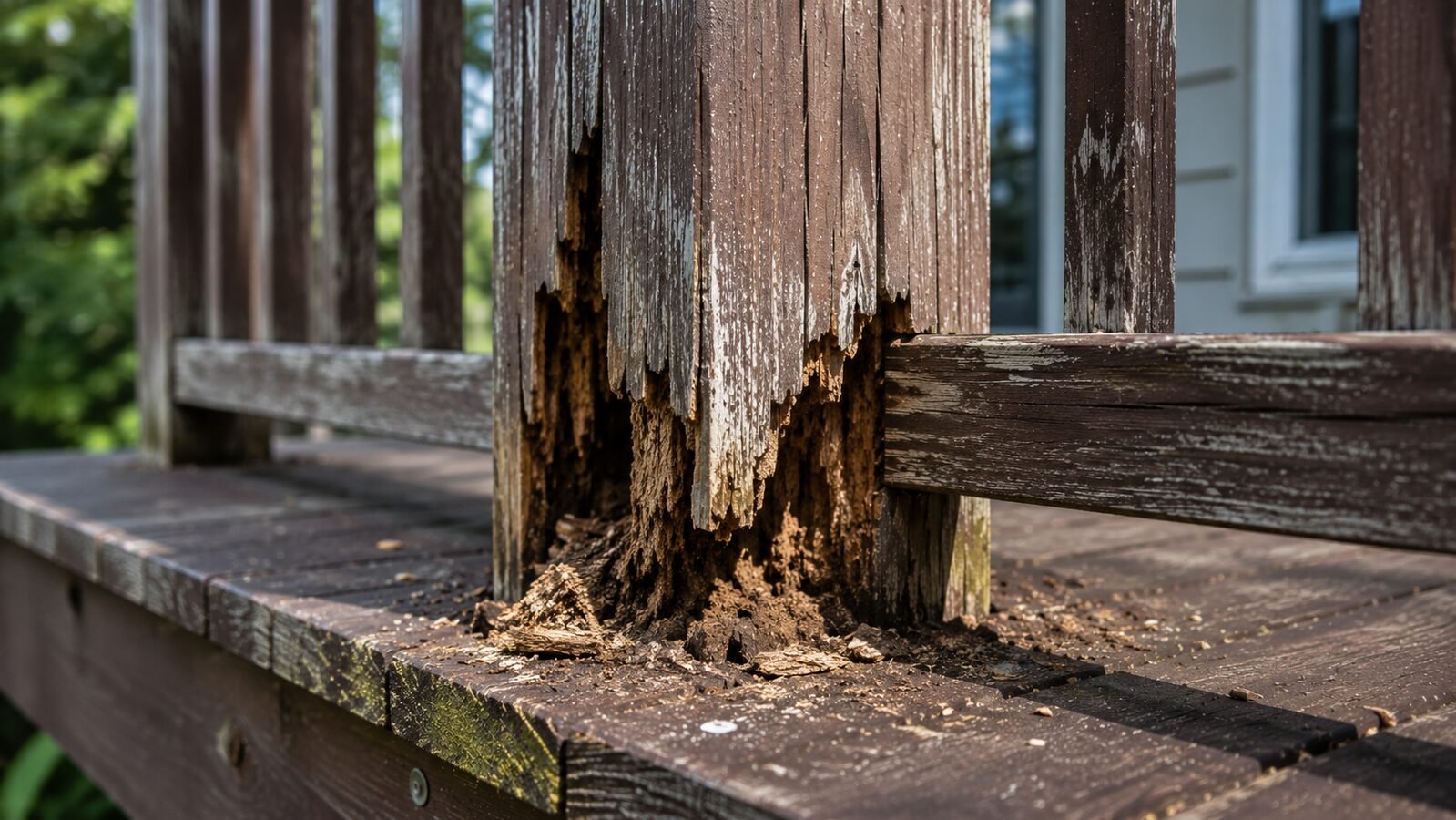
You cannot repair what you have not located. Play at the top starts in four or five places, the remedy for each differs, and a flashlight settles it in twenty minutes. The sequence below is close to what ABD Inspections works through on site, so running it yourself tells you what a report would say.
- Load the top and watch the base. Press steadily, do not shake. If the upright rocks while the framing stays put, the joint at its foot is your answer.
- Press again and watch the framing. If the band joist travels with it, the failure sits further back, where it separated from its joists. If the whole platform sways, that is how to fix a wobbly deck — bracing and post bases, not the guard.
- Look for a notch. A cut at the bottom, made so the member could sit on the walking surface, is the worst detail in residential work and never improves.
- Probe the wood. Push a screwdriver into the base and the band joist behind. Anything that yields is decay, and no hardware repairs decay.
- Read the metal. Rust streaks, backed-out screws, elongated holes, spinning washers — all of it says the joint has worked for years.
- Check the neighbours. Find one bad upright and the question becomes how to fix loose railing post by post, because the rest went in the same day, same crew, same detail.
That last point changes the size of the job. Owners find one bad upright and call it isolated. A loose railing repair confined to one spot, where every joint is identical, buys false confidence and nothing more.
Why Tightening What Is Already There Rarely Works
The first thing everyone tries is a wrench, and it is worth knowing why that disappoints. A lag screw takes its holding power from wood fibre gripping the threads. Once the joint has moved through a few thousand cycles of load and weather, fibre around the shank is crushed and the hole enlarged. Turning the head compresses damaged wood, not fresh material.
So how to tighten railing post hardware is the wrong question. Torque restores the feel of solidity for a season while adding nothing to capacity, and it hides the condition behind a firm handhold. It also fails at inspection, because an inspector loads the assembly rather than checking a nut. The joint has to be rebuilt on a different principle, not re-torqued on the old one. That is the short answer to how to fix a loose railing: rebuild the connection, do not re-tension it.
The Repair That Holds
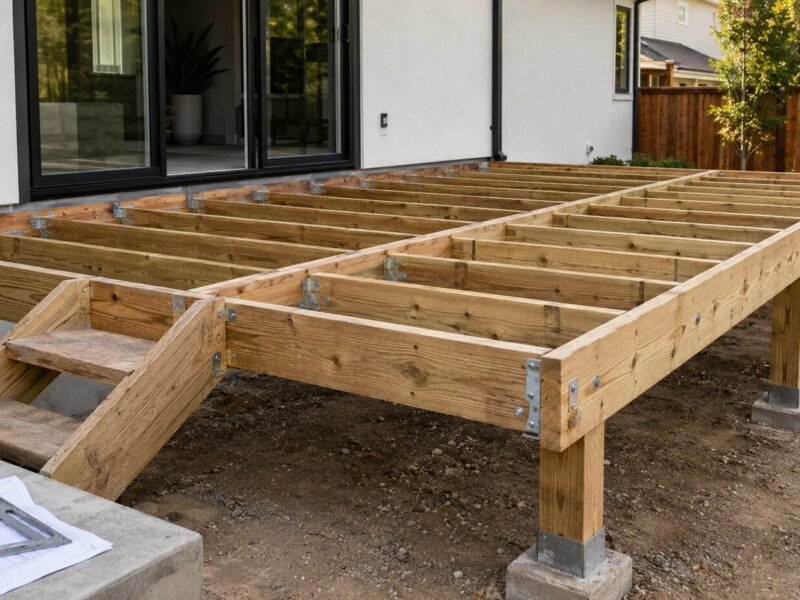
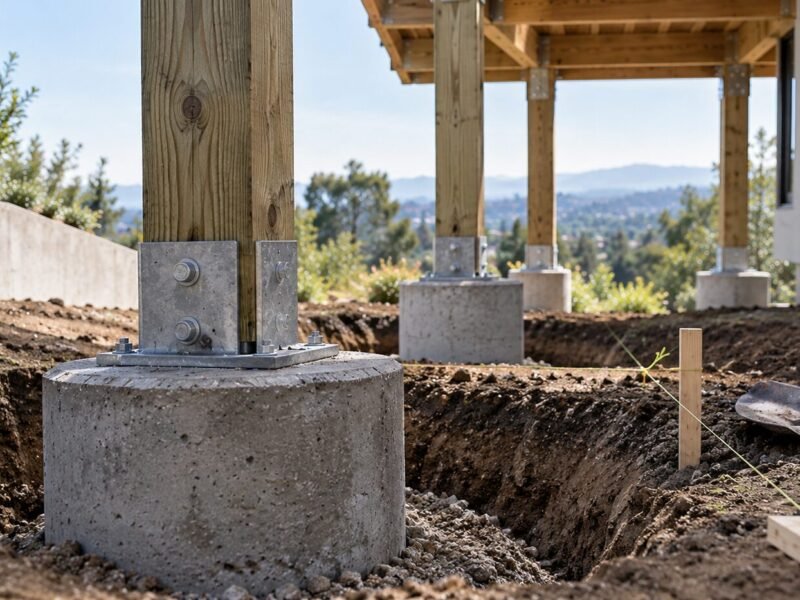
The Virginia Tech team did not stop at demolition; they developed and tested a detail that passes. The principle is simple: stop asking the band joist to resist the whole moment, and route the tension into the joists running perpendicular. A hold-down tension device — the researchers used a Simpson HD2A mounted sideways on a joist — takes the outward pull at the base and delivers it into framing that resists it.
Practically, how to reinforce deck railing posts on an existing structure is four moves. Solid blocking goes between the joists either side, fastened so it cannot rotate. The upright gets through-bolts with washers, not lag screws, since a bolt in double shear behaves nothing like a screw on withdrawal. Tension hardware ties the base into that blocking. And any notch goes entirely — a 4×4 with grain sloping 1:8, notched 1¾ inches deep, drops to ¾ inch of sound section eight inches up as a crack travels the grain.
None of this is exotic, though it means opening the underside for access. Reinforcing deck railing connections properly takes an afternoon per upright and a few dollars of hardware. Doing it from above with longer screws takes twenty minutes and accomplishes nothing — which is why so many barriers were tightened three times and still move.
Rot, Corrosion, and What Hides at the Base
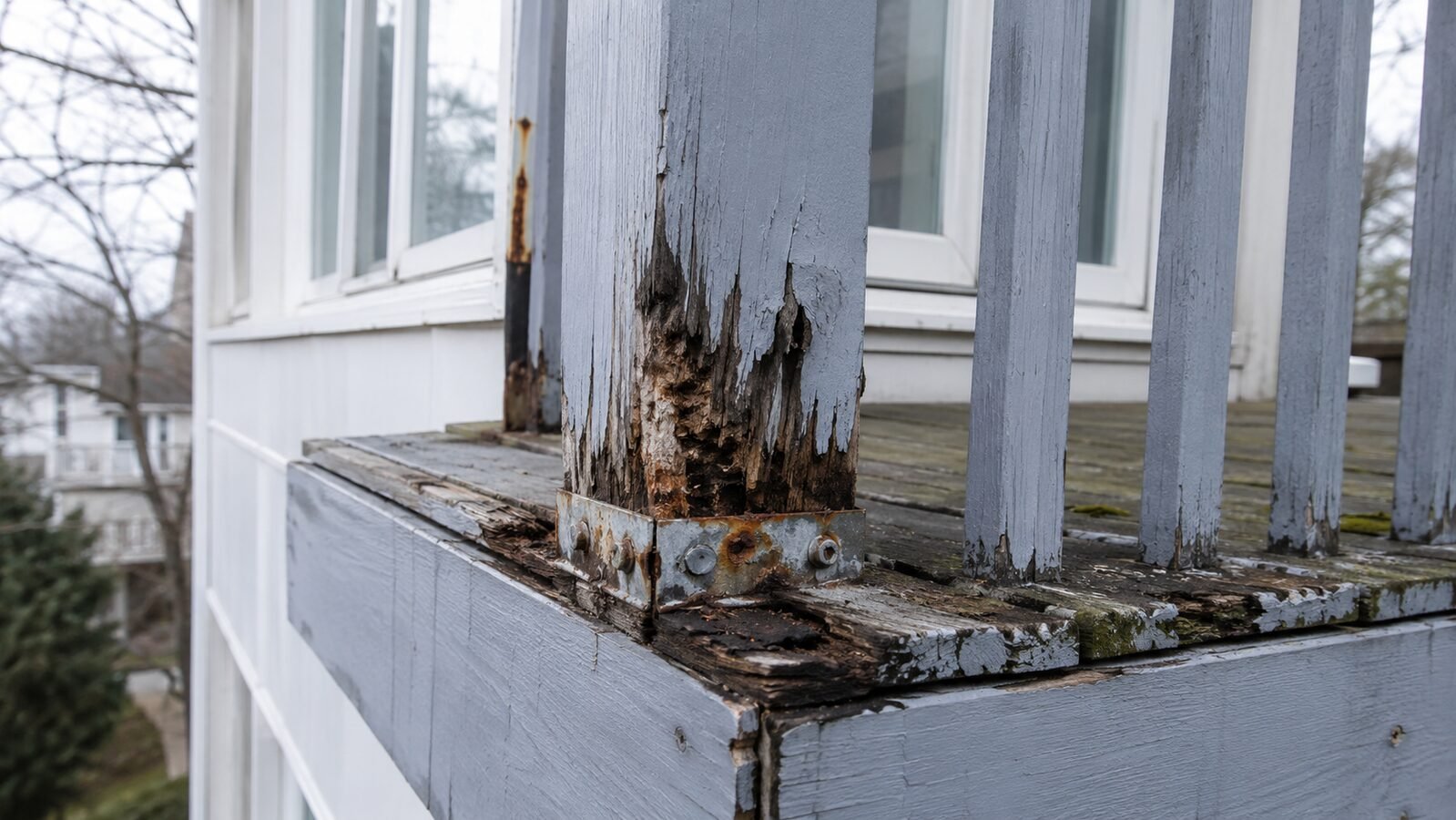
Before new hardware goes in, the wood and metal already there need an honest look. The items below kill these joints across the Sacramento Valley, where hundred-degree summers alternate with saturated winters, and any one turns a simple job into a large one.
- End grain on the walking surface. An upright flat on boards wicks water into its own end. The outside looks sound while the core softens, so probe rather than look.
- Corrosion from treated lumber. Preservative chemistry eats zinc-plated steel. Rust bleeding down a face means the fastener lost section where nobody can measure it — and in San Francisco metal assemblies answer to Section 604.
- Water trapped behind. A face bolted tight to a band joist holds moisture for weeks, and decay spreads before anything shows.
- The band-joist-to-joist joint. Where testing found most specimens failing. Two-inch screws behind a band joist never were meant to carry a ton.
- Sleeved and composite uprights. A wrap over a wood core hides everything, and looks perfect the day it gives up.
- Fasteners wrong from the start. Drywall screws, deck screws in structural roles, empty connector holes — routine on old work.
Decay ends the conversation. No hardware makes a rotten member pass, because an inspector is not grading the bolt but whether sound wood exists to take the load. Soft fibre at a post base or band joist is written up as a structural finding. Covered structures follow the same rule, so planning to repair porch railing connections means the same probe test: a roof slows weathering without stopping water down an upright or delta air on steel. Corrosion runs second, since a fastener that lost section cannot be judged outside. Budget to fix porch railing joints as though exposed, because the parts that matter usually are.
When the Post Has to Come Out
Jurisdictions around the capital differ on whether this needs a permit, so one call to the counter before you fix deck railing posts settles that. Some conditions rule out repair: a crack from a notch corner, wood soft enough to take a screwdriver a quarter inch, a split from an old bolt hole, a base wet enough to darken through. Each means the member is finished structurally, and a bracket over decay does not pass — it hides the finding until the next report.
Sorting out how to fix a loose railing at this stage means replacement, not reinforcement. What follows is a matter of order, and order stops a new member inheriting the old defect. Get how to replace deck railing post and blocking sequenced right and the rest is carpentry: support the top, pull the old upright, correct the cause, set blocking and tension hardware, stand the replacement. A fresh upright in the old hole reproduces the defect in new lumber. While the framing is open, fixing deck posts carrying the structure deserves the same look — a barrier is only as fixed as whatever stands under it.
What the Law Adds on Rental and Association Property
A private homeowner answers to the permit and their own judgment. Owners of income property carry a duty on a schedule that reaches these joints directly. Health and Safety Code Section 17973 covers buildings with three or more dwelling units, naming guards inside the scope of every exterior elevated element by statute rather than interpretation. AB 2579 pushed the first deadline to January 1, 2026, with a sixth-year cycle after. Community associations answer instead to SB 326, whose first round closed at the start of 2025 and returns every ninth year, with the work reserved to architects and engineers.
A manager therefore cannot treat this as deferred maintenance. Deciding how to fix a loose handrail on a rented balcony is not purely a repair choice; it is a documented item with a deadline. Findings that threaten immediate safety carry the shortest timelines, and a report recording movement starts a clock on both the permit and the completed work.
Before You Trust It Again
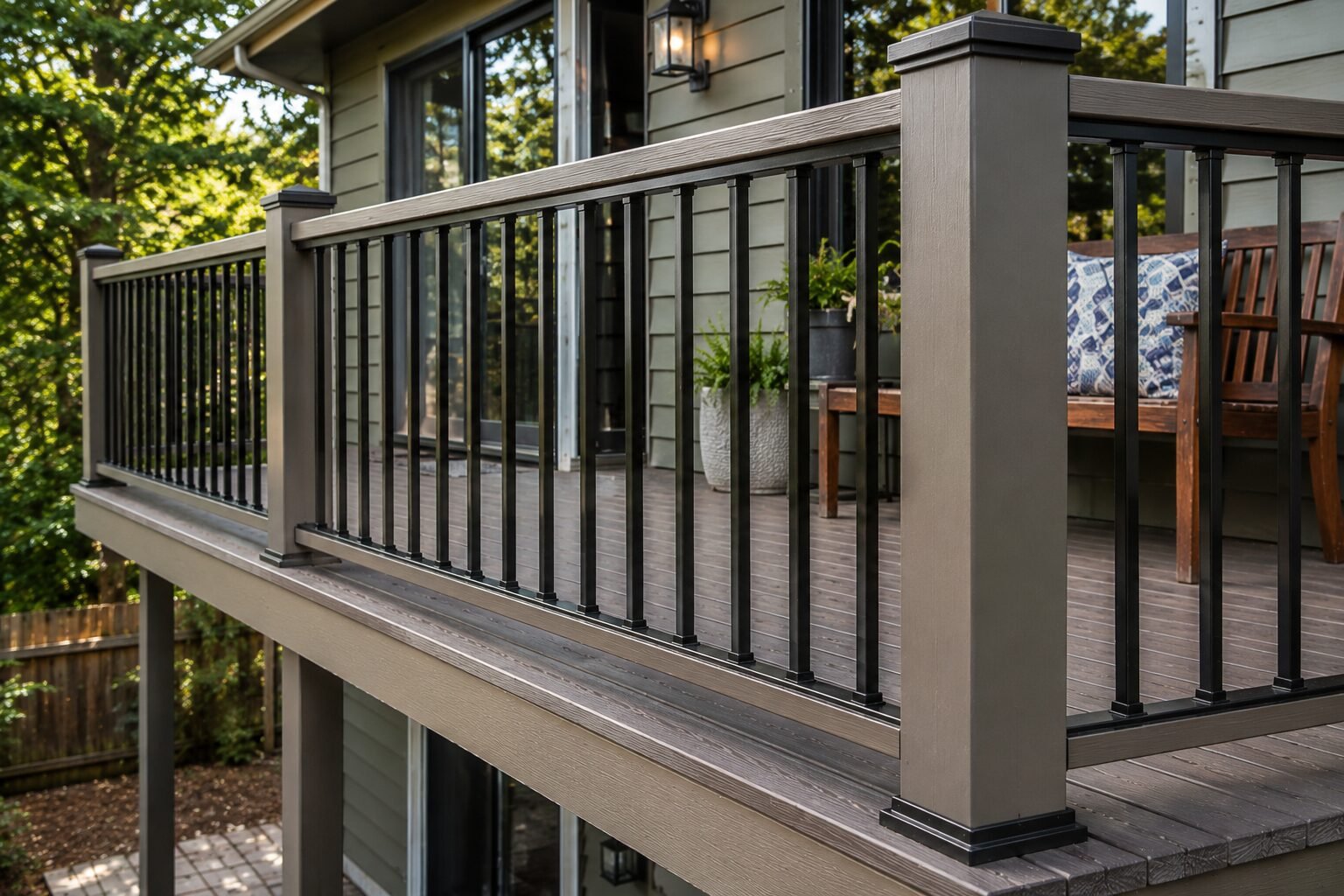
Verification is the step people skip, and it is the same two minutes an inspector spends. Lean in with real weight, not a polite push — the standard is 200 pounds, and a nudge proves nothing. Confirm the geometry too, because it gets measured: California wants guards at 42 inches minimum along a walking surface, 34 along the open side of a flight, and no gap passing a 4-inch sphere.
Anybody who thinks seriously about this reaches the researchers’ conclusion. The visible parts rarely matter; the joint you cannot see decides whether it holds. The same goes for a covered entry, where knowing how to fix a porch railing properly starts with finding what sits behind it. Sleeves, skirt boards, and paint hide exactly the joint that decides it. Whether the question is how to fix railing on deck or on a porch, it begins the same way: open one joint before committing to a method. If probing turns up soft wood anywhere along the run, bring in a licensed inspector while the question is still hypothetical rather than after a report records it.