Structural Repair
- Joist, beam, and rim replacement
- Ledger board reinforcement and re-flashing
- Connection hardware upgrades
- Support post and deck footing reconstruction
Sacramento County · SB 721 & SB 326 specialists
Natomas was built in three waves, and the last one began only after a seven-year pause. South Natomas filled in from the 1950s to the 1980s, North Natomas grew quickly from the mid-1990s, and after a flood-related building stop from 2008 to 2015, a new round of construction began. Each wave has its own balcony, stair, and walkway details. We provide balcony inspection under SB 721 for apartment communities and under SB 326 for condo associations throughout Natomas, from the complexes near Garden Highway and the I-5 office parks to Natomas Park, Westlake, Regency Park, and Natomas Crossing. Deck repair is carried out by the same licensed team that does the inspection.
Inspection, compliance, repair, and reconstruction for Natomas apartment owners, HOA boards, and property managers — handled end‑to‑end by one licensed team.
What type of property do you manage?
Which exterior structures are 6 feet or more above ground?
Select all that apply
Get your free compliance assessment
We'll send your personalized report within 24 hours
Thank you! We'll contact you within 24 hours with your personalized compliance report.
Wood framing carries most apartment and condo balconies in Natomas. In South Natomas, the older complexes have open wood balconies and stairs with painted wood guardrails. In North Natomas, many buildings from the late 1990s and 2000s have balconies wrapped in stucco, with a coated deck surface and a stucco soffit underneath. During a deck inspection, we adjust the method to the building: open framing is inspected directly, while stucco-wrapped balconies need moisture probes and small inspection openings.
From the street, many North Natomas balconies look like concrete: smooth stucco on the face, a stucco ceiling below, and a hard coated surface on top. Owners sometimes take them for concrete and assume the state balcony laws do not reach them. In most cases they are wood-framed inside, and the law covers them. We confirm the structure of each balcony type on the property before the sample is drawn, so nothing covered is left out of the report.
Composite or vinyl railing systems are often added when older wood balconies in South Natomas are updated. The weak point of these systems is not the rail itself but the way each post is fastened to the wood rim or deck framing. A post mounted on a thin or decayed rim can move far more than it should under load. We load-test composite and vinyl railings in the sample and check the framing at each post base.
A 30-minute on-site walkthrough tells you exactly what's required.
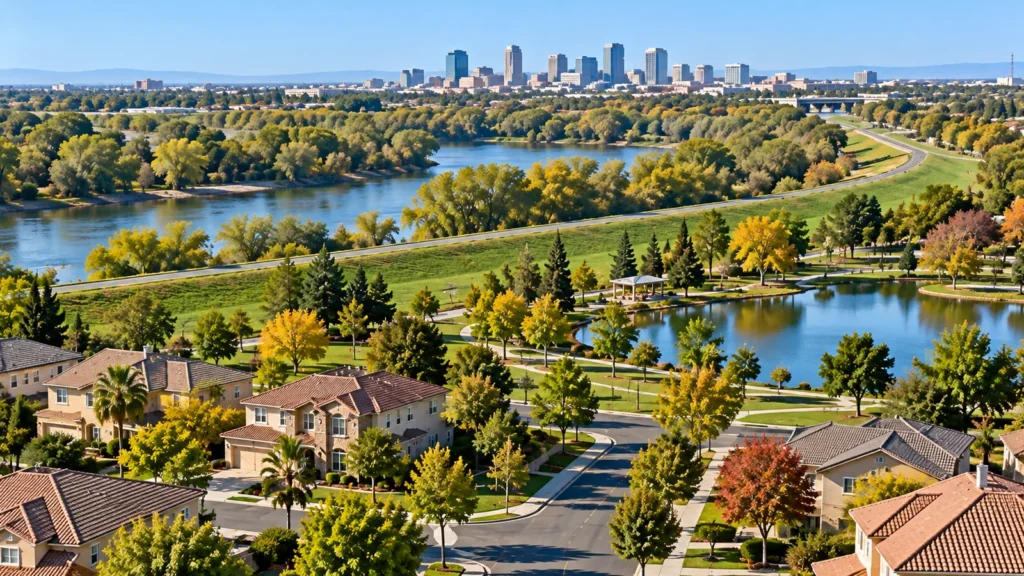
Natomas is the northwestern part of the City of Sacramento, bounded by the Sacramento River to the west and the American River and Garden Highway to the south, with Interstate 80 dividing it into North and South Natomas. South Natomas developed as residential subdivisions from the 1950s through the 1980s, and a 1982 plan amendment added office parks along Interstate 5. North Natomas was farmland on the river floodplain until the mid-1990s, when homes, apartments, offices, and shopping centers went up quickly around what was then ARCO Arena, the former home of the Sacramento Kings, torn down in 2022.
In 2008, FEMA mapped Natomas as a high-risk flood zone and required new floors to be 10 to 20 feet above the ground, which stopped new construction. After about $500 million was spent on 21 miles of levee around the basin, FEMA remapped the area, and building permits resumed on June 16, 2015. As a result, Natomas multifamily buildings fall into three clear groups: South Natomas buildings that are now 40 years old or more, North Natomas buildings from 1995 to 2008 that are reaching their first major repair cycle, and buildings completed after 2015 that are coming due for their first SB 721 inspection.
Natomas shares Sacramento's climate: annual rainfall near 18 inches across roughly 58 wet days, July afternoons averaging about 93°F, and around 14 days a year at 100°F or higher. On many summer evenings, the Delta breeze comes in from the bay and temperatures drop sharply overnight. The wide daily swing between hot afternoons and cool nights works on coatings, sealant joints, and stucco around balconies all summer, and the cracks it opens become entry points for water once the rainy season starts.
Issues that repeat across the local building stock — from climate, construction era, or common materials in this area.
Natomas is surrounded by river, wetland, and farmland habitat, and swallows and other birds build mud nests under balcony soffits, in corners, and on top of light fixtures. The nests and droppings stain stucco, block drains, and hold moisture against the wall. Removal is regulated while nests are active, so timing matters. We note every nest location in the report and recommend when and how the area should be cleaned and protected.
On stucco-wrapped balconies, the bottom edge of the wall stucco is supposed to stop just above the deck surface so water can drain out. When decks are recoated, the coating is often carried up over that edge, closing the drainage gap. Water then collects inside the wall above the deck. Our deck inspection looks at where the stucco ends on each wall of every sampled balcony.
Large North Natomas complexes were often built in phases, sometimes by different crews. Flashing, drain placement, and guardrail framing can change from one phase or building to the next. A sample taken only from one phase can miss a problem repeated across another. We map the phases first and spread the sample across them.
The California Fire Code restricts charcoal grills and other open-flame cooking devices on combustible balconies of apartment buildings, with some exceptions. Even so, we find scorched coatings, melted sealant, and heat-damaged siding where grills have been used. Besides the fire risk, damaged coatings let water into the framing. We record these spots and include them in the waterproofing scope.
When a deck is resurfaced with a thicker topping or new decking on sleepers, the walking surface rises and the guardrail effectively gets shorter. The California Building Code requires guards at least 42 inches high on apartment and condo buildings. We measure guard height from the current walking surface and flag any guard that a repair has brought below that height.
Natomas apartment communities with three or more units fall under SB 721 and its 6-year cycle, and as part of the City of Sacramento they are also subject to the City's Rental Housing Inspection Program, which does not replace the SB 721 inspection. We work with large garden-style communities in North Natomas and older complexes in South Natomas, and we coordinate tenant access with on-site management.
For Natomas condo associations, SB 326 requires a new inspection at least once a decade, every nine years to be exact, signed by a licensed structural engineer or architect. Because many complexes here were built in phases, we draw the random sample across all phases of the community rather than from one section.
Natomas HOA boards get a report that groups findings by phase and building type, a priced repair plan, and a closing letter the board can hand to its insurer or attach to lender questionnaires. We file the permits with the City of Sacramento.
Townhome communities, fourplexes, senior and income-restricted apartments, condo complexes, and newer multifamily buildings near the Natomas town centers.
Serving all of Natomas with fast response times. Most assessments within 3 business days.
After the work is complete, you walk away with a full archive package — ready for your HOA board, insurer, city, or next property sale.
Before, during, and after photos tagged to every structural element inspected.
Full permit package, inspection card sign-offs, and city correspondence archived.
Manufacturer warranties plus our labor guarantee in writing.
Detailed scope-of-work summary covering every repair and reinforcement.
Engineer-signed SB 721 / SB 326 letter for your HOA archive, insurance, and lender.
The Natomas package also contains a site map showing the construction phases and which buildings were sampled from each, plus guard height measurements taken after any resurfacing work.
We walk the property, identify scope, and flag any urgent safety items. No cost, no obligation.
Full proposal with line-item pricing, material specs, and a realistic timeline.
We handle city permits and coordinate tenant notices with property management.
One licensed crew, start to finish. Daily photo updates and clean worksites.
City sign-off, warranty package, and compliance letter delivered to you.
Our community was built in three phases, and we only knew that from old plans. ABD sampled all three and found that the drains in the second phase were set too high on almost every balcony. A sample from one phase would have missed it.
We assumed our balconies were concrete. ABD showed us the wood framing behind the stucco and explained why they were covered by SB 326.
Yes. Buildings from 1995 to 2008 are now roughly 20 to 30 years old. At that age, original deck coatings, sealant joints, and flashing are often at the end of their service life, and leaks that started years ago may already have reached the framing. These buildings are also large and repetitive, so a single detail error can repeat on hundreds of balconies.
Many birds that nest on buildings, including swallows, are protected under the federal Migratory Bird Treaty Act, and active nests generally cannot be disturbed. Inactive nests can usually be removed outside the nesting season, and deterrents can be installed to keep birds from returning. Before removing nests, check the current rules with a wildlife professional. We note nest locations and the damage they cause so the repair can be scheduled at the right time.
The California Fire Code restricts charcoal grills and other open-flame cooking devices on combustible balconies and within 10 feet of combustible construction on apartment buildings, with exceptions that include sprinklered buildings and small propane cookers. Rules can vary with local amendments, so check with the Sacramento Fire Department. For the inspection, what matters is any heat damage to coatings, sealant, or siding, which we record and repair.
In the wrong city? Jump to the right page for your property.
Tell us about your property and we'll come out, walk it, and give you a written plan — free of charge, no obligation.