Structural Repair
- Joist, beam, and rim replacement
- Ledger board reinforcement and re-flashing
- Connection hardware upgrades
- Support post and deck footing reconstruction
Nevada County · SB 721 & SB 326 specialists
Grass Valley gets more than 50 inches of rain a year, freezing nights in winter, and some snow, on a housing stock where about one home in five was built before 1940. Almost half of the city's homes are in multifamily buildings, and most households rent. Our balcony inspection work covers apartment owners under SB 721 and condo associations under SB 326 across Grass Valley, from older buildings downtown around Main Street and Mill Street to the complexes along Sutton Way, Brunswick Road, and the Nevada City Highway. When the report finds damage, our crew completes the deck repair.
Inspection, compliance, repair, and reconstruction for Grass Valley apartment owners, HOA boards, and property managers — handled end‑to‑end by one licensed team.
What type of property do you manage?
Which exterior structures are 6 feet or more above ground?
Select all that apply
Get your free compliance assessment
We'll send your personalized report within 24 hours
Thank you! We'll contact you within 24 hours with your personalized compliance report.
Grass Valley has two very different groups of wood balconies and stairs. Downtown and in the older neighborhoods, many apartments occupy buildings from before 1940, where balconies and rear stairs were built long before modern flashing and connector standards and have been altered many times since. Elsewhere, apartment and condo complexes from the 1970s onward have conventional wood framing with coated walking surfaces. Our deck inspection follows a different plan for each, with more opening of finishes on the older buildings, where the framing is hardest to read from outside.
Concrete in Grass Valley's elevated elements is mostly found at the base: steps, stair landings, and footings that support wood stairs and walkways. With January lows around freezing, water that soaks into concrete freezes and expands, and over many winters the surface flakes off and cracks widen around embedded post bases and anchor bolts. We check concrete supports for spalling and cracking and look at how the wood above them is anchored.
Composite boards perform well in wet weather, but winter adds two concerns. Frost and ice make some boards slick, and metal shovels can scratch or gouge the protective surface of capped boards, after which they absorb water and stain. Many manufacturers call for plastic shovels and specific ice-melt products. We check the condition of composite surfaces for winter damage and inspect the framing beneath them.
A 30-minute on-site walkthrough tells you exactly what's required.
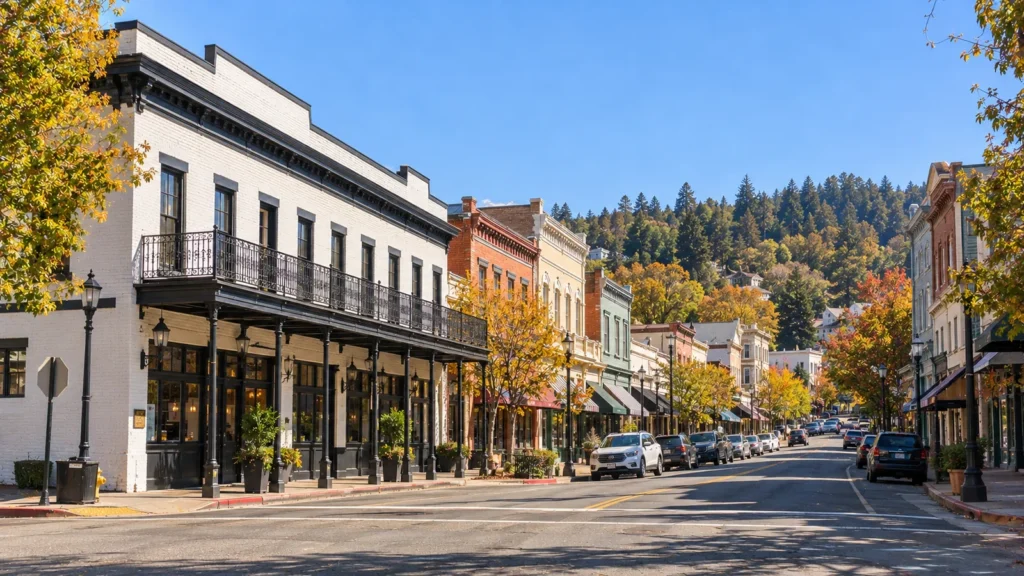
Grass Valley is a Gold Rush town. The Empire Mine, now a state historic park inside the city, operated for more than 100 years until 1956, produced about 5.8 million ounces of gold, and left 367 miles of underground workings. On September 13, 1855, a fire that started in the United States Hotel on Main Street destroyed more than 300 buildings over about thirty acres, and only two structures in the business district survived. The town rebuilt quickly, and some of the historic downtown buildings now have apartments above their storefronts.
The City's housing element shows a building stock unlike most Northern California cities. Grass Valley had about 13,000 residents and 6,696 housing units in 2018. About 59% of households rent. Multifamily buildings hold 46% of all units: 31% sit in larger buildings with at least five units and 15% in two-, three-, and four-unit buildings. About 21% of homes were built in 1939 or earlier, and the median year built is 1973. A citywide survey in 2007 found about 6% of the units it covered in need of substantial repair or dilapidated. For SB 721, this means many small and older rental buildings, where an inspection has to read framing from very different periods.
Grass Valley sits in the Sierra foothills and averages about 54 inches of precipitation a year, with around 9 inches of snow in a typical year. July afternoons average about 87°F, and January ranges from highs near 53°F to lows around 33°F. That is roughly three times the rainfall of Sacramento in the valley below, with frequent nights near freezing. Water reaches more parts of a balcony here, stays longer, and on cold nights freezes inside cracks and joints, which opens them further every winter.
Issues that repeat across the local building stock — from climate, construction era, or common materials in this area.
In years with snow, balconies and walkways that are not cleared carry extra weight, and the snow melts slowly against the membrane and the wall, keeping the framing wet for days. Shoveling with metal tools can cut coatings and membranes. We look for cuts and worn areas on walking surfaces and suggest clearing methods that protect them.
Rock salt and other chloride ice-melt products are often used on stairs and walkways in cold snaps. Salt residue corrodes metal connectors, nails, and guardrail bases and can break down some coatings. We check hardware on stairs and walkways for salt corrosion and suggest ice-melt products that the coating manufacturer approves.
Water that gets into cracks in coatings, sealant joints, and concrete freezes on cold nights and expands. Each cycle pushes the crack a little wider, and in a wet winter with many cold nights, small openings become large ones quickly. We record crack locations and widths so repairs can be scheduled before the next winter.
On buildings where a roof slopes toward a lower balcony or stair, snow and ice can slide off in a single mass and strike the guardrail or deck below. Impact like this can bend guardrails, crack posts, and loosen connections. We check the elements under roof edges for impact damage and note where snow guards or a different roof edge detail would help.
Balconies and rear stairs on the oldest buildings were often built with no flashing at the wall at all, and many were patched or extended over the decades. In Grass Valley's rainfall, the wall line on these balconies is often where water damage is most advanced. We open finishes at the wall on older buildings and record what we find before the repair is designed.
Grass Valley rentals with three or more units come up for SB 721 inspection every six years. Many of the city's rentals are in small or older buildings, from upper-floor apartments downtown to garden complexes on Sutton Way and Brunswick Road, and we inspect each with the same method. We set entry dates with the owner or manager well ahead of the visit.
Grass Valley condo associations follow SB 326. Their inspection repeats every nine years, and the signature on it must be a licensed structural engineer's or architect's. The CC&Rs tell us which elevated elements are the association's to maintain, and the random sample is drawn from that list.
For HOA boards in the foothills, our report separates winter-related damage, such as freeze cracking, ice-melt corrosion, and snow impact, from ordinary wear, so the board can plan seasonal maintenance as well as repairs. Each repair is priced, and the board also receives the permit file and the final compliance letter.
Three- and four-unit buildings, older houses split into several apartments, apartments above downtown storefronts, senior housing, and townhome communities.
Serving all of Grass Valley with fast response times. Most assessments within 3 business days.
After the work is complete, you walk away with a full archive package — ready for your HOA board, insurer, city, or next property sale.
Before, during, and after photos tagged to every structural element inspected.
Full permit package, inspection card sign-offs, and city correspondence archived.
Manufacturer warranties plus our labor guarantee in writing.
Detailed scope-of-work summary covering every repair and reinforcement.
Engineer-signed SB 721 / SB 326 letter for your HOA archive, insurance, and lender.
Grass Valley packages also include a winter care sheet for the repaired balconies and stairs: how to clear snow without damaging the surface, which ice-melt products to use, and what to check each spring.
We walk the property, identify scope, and flag any urgent safety items. No cost, no obligation.
Full proposal with line-item pricing, material specs, and a realistic timeline.
We handle city permits and coordinate tenant notices with property management.
One licensed crew, start to finish. Daily photo updates and clean worksites.
City sign-off, warranty package, and compliance letter delivered to you.
Our building downtown dates from the late 1800s, with apartments upstairs and a rear stair added at some point nobody remembers. ABD opened the wall where the landing meets the building and found water damage that would never have shown from outside.
Snow sliding off our roof had been hitting the same balcony railings for years. ABD found two cracked posts and suggested snow guards along that roof edge, which solved it.
Yes, in two ways. Snow adds weight, and wet snow that is not cleared can add a lot of it on a small balcony. It also melts slowly against the membrane and the wall, which keeps the framing wet. Clearing snow with plastic tools, keeping it off the outer edge, and avoiding rock salt all help the balcony last longer.
It can. Buildings in historic areas may be subject to the City's historic preservation policies, and changes to visible features such as balconies, railings, and stairs can require review before a permit is issued. We check with the City at the start of the project and design repairs that match the building's character while meeting safety requirements.
Structural repairs to framing, connections, and guardrails can be done most of the year. Waterproofing is different: most coatings and membranes need dry surfaces and minimum temperatures set by the manufacturer to cure properly, so that part of the work is usually scheduled for spring through fall. We plan the sequence so the balcony is safe and protected in between.
In the wrong city? Jump to the right page for your property.
Tell us about your property and we'll come out, walk it, and give you a written plan — free of charge, no obligation.