Structural Repair
- Joist, beam, and rim replacement
- Ledger board reinforcement and re-flashing
- Connection hardware upgrades
- Support post and deck footing reconstruction
Placer County · SB 721 & SB 326 specialists
Granite Bay is mostly owner-occupied, so here the state balcony laws reach fewer buildings than in most Sacramento-area communities, and the ones they do reach are mainly townhome and condo associations. Some larger homes near Folsom Lake also have tall decks, which no law requires anyone to inspect. We provide SB 326 inspections for associations, SB 721 inspections for the rental buildings that need them, and voluntary deck inspection for homeowners, along Douglas Boulevard, Auburn-Folsom Road, Eureka Road, and the neighborhoods near the lake. Any deck repair that follows is handled by our own crew, so the inspection and the work stay in one place.
Inspection, compliance, repair, and reconstruction for Granite Bay apartment owners, HOA boards, and property managers — handled end‑to‑end by one licensed team.
What type of property do you manage?
Which exterior structures are 6 feet or more above ground?
Select all that apply
Get your free compliance assessment
We'll send your personalized report within 24 hours
Thank you! We'll contact you within 24 hours with your personalized compliance report.
Most elevated decks in Granite Bay are on townhomes, halfplexes, condos, and larger single-family homes rather than on apartment buildings. Some are framed with large solid-sawn beams and posts, wrap around trees, or attach to walls finished in stone veneer. Each of these details affects how water moves and where water damage starts. Our deck inspection looks at the large timbers, the connections to the house, and the places where the deck meets trees, stone, or a neighbor's deck.
Granite Bay sits on granite bedrock, and on some lots deck posts stand on boulders or on footings pinned to exposed rock. Where concrete has been poured against granite, water can run along the joint and collect under the post base, and steel pins set into rock can corrode below the surface. We check every footing in the sample that bears on rock for movement, cracking, and corrosion at the anchor.
Composite boards can be damaged by sunlight reflected from large energy-efficient windows. On houses and townhomes with big glass walls facing a deck, the concentrated reflection can heat a strip of composite enough to warp or discolor it. We look for heat marks and distortion on composite decks near large windows and check the framing underneath any damaged area.
A 30-minute on-site walkthrough tells you exactly what's required.
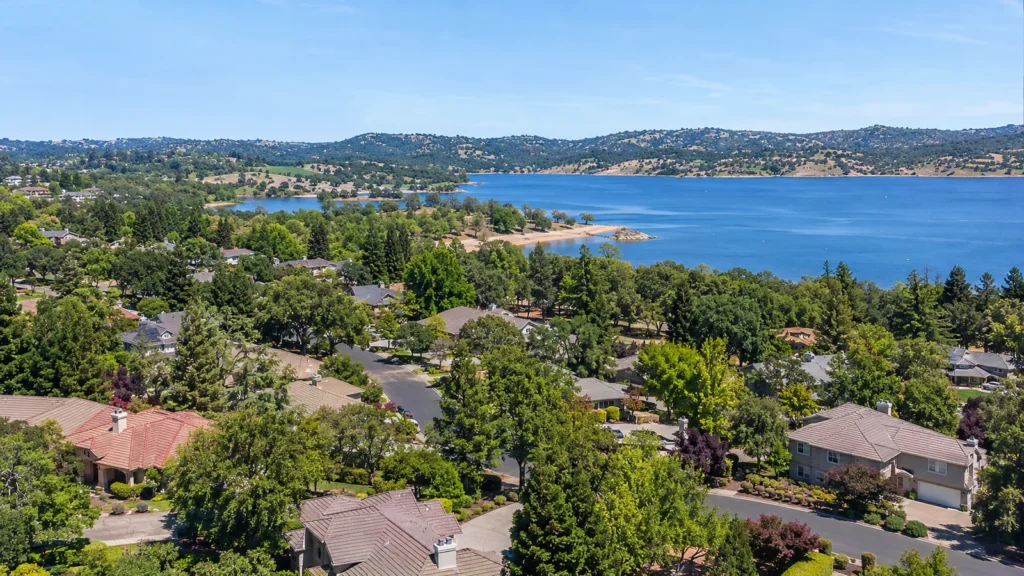
Granite Bay takes its name from a bay in Folsom Lake on the community's east side, and the ground beneath it is granodiorite of the Penryn Pluton. It is an unincorporated community in Placer County, so building permits come from the County, and land use follows the Granite Bay Community Plan, which the Board of Supervisors last updated in July 2019. Its trees and granite ground shape how decks here are built and how they age.
At the 2010 Census, Granite Bay had 20,402 residents and 7,542 housing units, and only about 11% of the units were occupied by renters. Attached housing is limited; one example is a 52-unit halfplex development at Douglas Boulevard and Auburn-Folsom Road, approved by the County in 2007. For our work, this means SB 721 applies to relatively few buildings, SB 326 applies to condo associations whose buildings have three or more units, and many owners of halfplexes and single-family homes choose a voluntary inspection instead.
The local climate is classed as hot-summer Mediterranean, with an average annual high of about 74°F and an average low of about 50°F. Temperatures have ranged from 16°F to 115°F, and January is the wettest month, with about 4 inches of rain, part of roughly 20 inches a year. Long, hot summers dry decks out and heat composite and coatings, and winter storms then wet the large timbers, the wood around tree trunks, and the rock joints where water can sit.
Issues that repeat across the local building stock — from climate, construction era, or common materials in this area.
Many decks here are built around oaks and other trees, with an opening cut in the decking and framing. As the trunk grows and moves in the wind, it can press against the framing, lift boards, or crack the members around the opening. Leaves and debris also collect in the gap. We check the clearance around every tree in the sample and the condition of the framing that surrounds it.
Decks are often pressure washed before staining or a sale. Too much pressure strips soft wood fibers, raises the grain, and opens checks that then hold water, and it can force water into joints and behind flashing. We look for signs of washing damage on wood surfaces and suggest gentler cleaning methods in our maintenance notes.
On homes and townhomes with stone veneer walls, the deck ledger is sometimes attached through the stone or set against it. Stone veneer needs its own drainage layer, and a ledger that interrupts it can send water into the wall and the ledger itself. We check how ledgers meet stone-faced walls and whether flashing continues behind the veneer.
On halfplexes and townhomes, two owners' decks often meet at the line between units, sometimes with one shared beam or post. The joint between them is easy to overlook, and responsibility for it can be unclear. We inspect these shared joints and point out where flashing, framing, or ownership needs to be clarified.
Large solid-sawn beams develop deep checks, or splits along the grain, as they dry. When a check opens on the top of a beam, it collects rain and softens from the inside. The tops of large beams in the sample are probed, and where a check is open to the weather, the report calls for a cap or flashing.
Granite Bay has relatively few rental buildings, but any with three or more units falls under SB 721 and needs an inspection every six years. We handle these buildings the same way as larger complexes elsewhere, with a sample suited to their size and a short, clear report.
SB 326 reaches condo buildings of three units or more. In those, a random selection of the association's elevated elements has to be inspected every nine years or sooner, and the signature on the report must belong to a licensed structural engineer or architect. Our first step is to sort out which buildings in the community reach that size and which elements belong to the association under its CC&Rs.
A Granite Bay HOA board may oversee halfplexes, townhomes, and small condo buildings in the same community. Our report separates what the law requires from what is optional, lists findings by building and by owner, and includes prices, County permits, and a compliance letter where one applies.
Halfplexes, townhome communities, small condo buildings, senior communities, and a limited number of apartment buildings.
Serving all of Granite Bay with fast response times. Most assessments within 3 business days.
After the work is complete, you walk away with a full archive package — ready for your HOA board, insurer, city, or next property sale.
Before, during, and after photos tagged to every structural element inspected.
Full permit package, inspection card sign-offs, and city correspondence archived.
Manufacturer warranties plus our labor guarantee in writing.
Detailed scope-of-work summary covering every repair and reinforcement.
Engineer-signed SB 721 / SB 326 letter for your HOA archive, insurance, and lender.
For Granite Bay homeowners and halfplex communities that are not covered by SB 721 or SB 326, the package is the same, except that the final letter documents a voluntary inspection and repair rather than legal compliance. Placer County permit records are included for all repair work.
We walk the property, identify scope, and flag any urgent safety items. No cost, no obligation.
Full proposal with line-item pricing, material specs, and a realistic timeline.
We handle city permits and coordinate tenant notices with property management.
One licensed crew, start to finish. Daily photo updates and clean worksites.
City sign-off, warranty package, and compliance letter delivered to you.
Our community is all halfplexes, and we were not sure what the law required of us. ABD explained that our buildings were not covered by SB 326, then did a voluntary inspection that found two shared decks with water damage along the line between units.
Our deck wraps around an old oak. ABD found the trunk pressing on the rim joist and cracked framing around the opening, and rebuilt that section with more clearance.
Usually not to the halfplex buildings themselves. SB 326 starts at condominium buildings of three multifamily units, and a halfplex has two. Any building in the community that has three units or more is still covered. After reviewing the recorded documents and the CC&Rs, we give the board a written list of any buildings the law reaches.
No. Neither state law reaches a single-family home. A tall deck over a slope or the lake still carries the same risks as any other elevated deck, though, and a voluntary inspection every few years is a good way to catch water damage and loose connections early. We inspect single-family decks with the same method we use for compliance work.
Yes. High pressure strips the soft surface of the wood, raises the grain, opens checks, and can push water behind flashing and into joints. A low-pressure wash with a suitable cleaner is safer for most decks. If a deck has already been pressure washed hard, we check it for surface damage and open checks during the inspection.
In the wrong city? Jump to the right page for your property.
Tell us about your property and we'll come out, walk it, and give you a written plan — free of charge, no obligation.