Structural Repair
- Joist, beam, and rim replacement
- Ledger board reinforcement and re-flashing
- Connection hardware upgrades
- Support post and deck footing reconstruction
Alameda County · SB 721 & SB 326 specialists
San Leandro more than doubled in size during the 1950s, and much of its housing still dates from that decade and the one after. On buildings that old, a balcony inspection deals with original framing, decades of partial repairs, and paint that may contain lead. Our work covers SB 721 for apartment owners, SB 326 for condo associations, and the deck repair those reports lead to, in every part of San Leandro: downtown along East 14th Street and Davis Street, Washington Manor, the marina area, and the neighborhoods along Foothill Boulevard, MacArthur Boulevard, and Hesperian Boulevard.
Inspection, compliance, repair, and reconstruction for San Leandro apartment owners, HOA boards, and property managers — handled end‑to‑end by one licensed team.
What type of property do you manage?
Which exterior structures are 6 feet or more above ground?
Select all that apply
Get your free compliance assessment
We'll send your personalized report within 24 hours
Thank you! We'll contact you within 24 hours with your personalized compliance report.
Many of San Leandro's apartment buildings from the 1950s and 1960s are two-story, wood-framed buildings with exterior stairs and balconies or walkways along the upper floor. Over sixty years, most have had parts replaced at different times: a few joists here, new decking there, a rebuilt stair. A deck inspection on these buildings has to separate original framing from later repairs and check how well the two are joined. We pay close attention to joist hangers and connections, where mixed repairs most often fall short.
Some older San Leandro buildings have exterior stairs with precast concrete treads bolted onto wood stringers. The treads are heavy and durable, but the wood stringers carry them, so the stairs are covered by SB 721. Water collects where each tread bears on the stringer and slowly rots the wood under the bolt. We inspect the stringer at every tread bearing in the sample and check the bolts for corrosion.
When older balconies are resurfaced with composite boards, many installers use hidden clip fasteners for a clean look. As the old framing below dries and shrinks, these clips can loosen, and boards begin to shift or lift at the ends. Loose boards are a trip hazard and a sign that the framing below may be moving. We check clip engagement on composite decks and inspect the joists underneath.
A 30-minute on-site walkthrough tells you exactly what's required.
San Leandro had 14,601 residents in 1940 and 27,542 in 1950, then grew to 65,962 by 1960, the largest jump in its history. After that, growth slowed: the 2020 Census found 91,008 residents and 32,898 housing units, and renters occupied 45.5% of the homes that were lived in. As a result, many apartments and small multifamily buildings here were built before 1978. That year matters for repairs, because federal lead-safe work rules apply to housing built before it.
The city runs from the bay shoreline and the San Leandro Marina up into the East Bay hills, and the Hayward Fault passes under Foothill Boulevard. The fault creeps slowly, generally 3.5 to 6.5 millimeters a year along most of its length, and is also capable of a large earthquake. In 2024, the City adopted an ordinance on soft-story residential buildings, those with weak first-floor wall framing. On buildings that fall under it, we coordinate balcony and stair work with any retrofit so access, permits, and tenant notices are handled once.
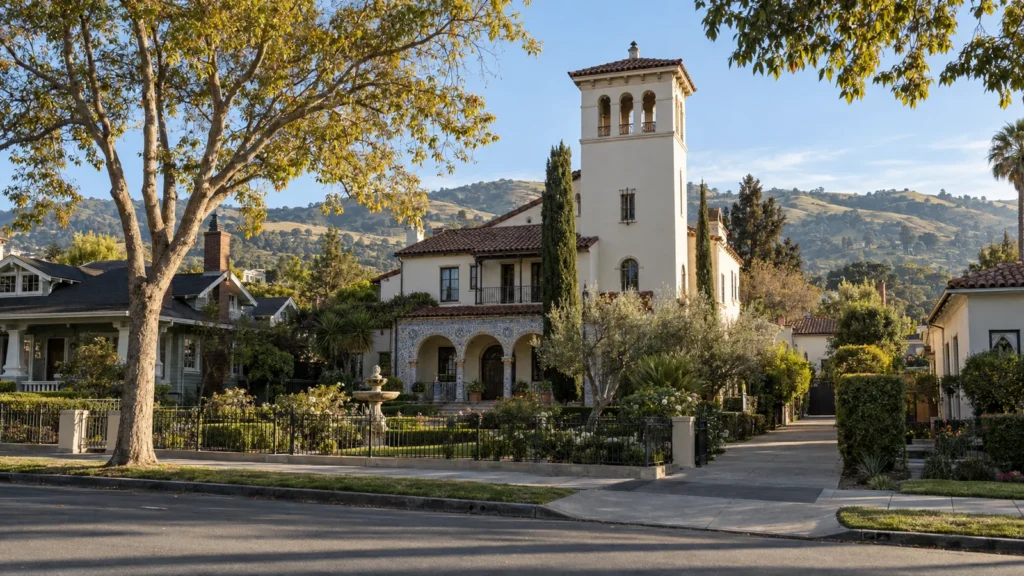
San Leandro shares the East Bay's mild climate. Next door in Oakland, annual rainfall averages about 22.6 inches over roughly 63 wet days, with January afternoons near 60°F and September afternoons near 75°F. With rain spread over a long, cool season and mild summers, the wood on older balconies goes through many wet-and-dry cycles each year rather than one long wet season. Paint and sealants crack under these cycles, and on older buildings the paint layers themselves become part of the repair question.
Issues that repeat across the local building stock — from climate, construction era, or common materials in this area.
Balconies, guardrails, and stairs on buildings from before 1978 often carry many layers of paint, and the older layers may contain lead. Scraping, sanding, or cutting these surfaces during repair can release lead dust. Under the EPA Renovation, Repair and Painting rule, work on pre-1978 housing that disturbs painted surfaces must follow lead-safe practices. We plan for this when we scope repairs on older buildings.
On repaired balconies, we often find joist hangers that have only some of their nails, or nails of the wrong type or length. A hanger without its full set of fasteners carries only part of its rated load. Hanger nailing is checked on every accessible connection we sample and corrected during repairs.
Balcony drains, downspouts, and plumbing lines added over the years were sometimes run through the balcony framing by cutting notches or large holes in joists. Cuts in the wrong place weaken the joist and can let water into the cut. We record every notch and hole we find and note which joists need reinforcement.
When only a few treads or one stringer of an exterior stair are replaced, the new pieces often do not match the old ones exactly. Steps of uneven height or depth are a common trip hazard. The building code limits the variation between steps in a flight to 3/8 inch. Our deck inspection measures risers and treads on sampled stairs and flags any flight that exceeds it.
Many owners have replaced old balcony doors with new sliding doors. If the new door was set without a sill pan or proper flashing below it, any leak at the frame ends up inside the wall and in the balcony framing. Stained floors or swollen trim inside the unit near the door are early signs. Sill flashing is checked at each sampled balcony door.
Under SB 721, San Leandro owners of rental buildings with at least three units must have the elevated elements inspected on a six-year cycle. Many are small 1950s and 1960s buildings near downtown and along East 14th Street, and others are larger complexes. We arrange tenant entry with the owner or manager, and when repairs disturb old paint, we follow lead-safe work practices.
San Leandro condo associations fall under SB 326, with a nine-year cycle and a report that only a licensed structural engineer or architect can sign. Before the random sample is chosen, we go through the CC&Rs to see which elements the association, rather than individual owners, must maintain.
San Leandro HOA boards receive findings sorted by building, with repairs listed in order of urgency and priced separately, so the board can approve the most important work first. We also obtain the permits and prepare the closing letter that insurers and lenders ask for.
Triplexes and fourplexes from the postwar decades, small courtyard apartment buildings, townhomes, and apartments above storefronts on East 14th Street.
Serving all of San Leandro with fast response times. Most assessments within 3 business days.
After the work is complete, you walk away with a full archive package — ready for your HOA board, insurer, city, or next property sale.
Before, during, and after photos tagged to every structural element inspected.
Full permit package, inspection card sign-offs, and city correspondence archived.
Manufacturer warranties plus our labor guarantee in writing.
Detailed scope-of-work summary covering every repair and reinforcement.
Engineer-signed SB 721 / SB 326 letter for your HOA archive, insurance, and lender.
On San Leandro buildings constructed before 1978, the package also records the lead-safe work practices used during repairs. Stair repairs include riser and tread measurements taken after the work, showing that each flight is within the allowed variation.
We walk the property, identify scope, and flag any urgent safety items. No cost, no obligation.
Full proposal with line-item pricing, material specs, and a realistic timeline.
We handle city permits and coordinate tenant notices with property management.
One licensed crew, start to finish. Daily photo updates and clean worksites.
City sign-off, warranty package, and compliance letter delivered to you.
Our 1950s building had been patched so many times that nobody knew which joists were original. ABD sorted it out joist by joist and found half the hangers from earlier repairs missing nails. The report made the repair scope easy to understand.
Tenants kept tripping on one exterior stair. ABD measured it and found the steps varied by almost an inch after an old repair. They rebuilt the flight with even steps.
It changes how the work is done. Under the EPA Renovation, Repair and Painting rule, repairs on pre-1978 housing that disturb painted surfaces must be done by a certified firm using lead-safe practices: containment, dust control, and proper cleanup. The inspection itself does not require this, but the repair scope and price account for it.
It can be. Mixed old and new treads often leave steps of different heights or depths, and the building code allows no more than 3/8 inch of variation within a flight. Replacing structural parts such as stringers can also require a permit. During the inspection we measure the stair and check the new parts and their connections, and list anything that needs correcting.
They are separate requirements, but the work can be scheduled together. A soft-story retrofit strengthens the ground floor of a building; SB 721 deals with the balconies, decks, stairs, and walkways on the upper levels. If both are coming up, combining access, permits, and tenant notices saves time and disruption for tenants.
In the wrong city? Jump to the right page for your property.
Tell us about your property and we'll come out, walk it, and give you a written plan — free of charge, no obligation.