Structural Repair
- Joist, beam, and rim replacement
- Ledger board reinforcement and re-flashing
- Connection hardware upgrades
- Support post and deck footing reconstruction
Sacramento County · SB 721 & SB 326 specialists
Licensed deck inspections and SB 721 / SB 326 compliance for North Highlands apartment owners, condo HOA boards, and property managers across one of the densest unincorporated apartment markets in the region. From the McClellan-area corridors and Watt Avenue to the Antelope Road, Don Julio Boulevard, Elkhorn Boulevard, and Larchmont Drive corridors — we deliver deck inspection reports signed by a certified deck inspector and ready to hand to your HOA archive, insurer, or lender.
Inspection, compliance, repair, and reconstruction for North Highlands apartment owners, HOA boards, and property managers — handled end‑to‑end by one licensed team.
What type of property do you manage?
Which exterior structures are 6 feet or more above ground?
Select all that apply
Get your free compliance assessment
We'll send your personalized report within 24 hours
Thank you! We'll contact you within 24 hours with your personalized compliance report.
Redwood and pressure-treated framing dominate North Highlands' base-era apartment stock built between the late 1950s and the late 1980s — particularly the dense garden-style complexes along Watt Avenue, Don Julio Boulevard, Larchmont Drive, and the corridors that originally housed McClellan personnel. We know which deck building eras used face-nailed ledgers versus early proprietary hangers, and where hidden rot typically collects under otherwise clean-looking finish boards in this corridor.
Mid-rise and three-story apartment projects along Watt Avenue and the Antelope Road corridor use suspended concrete balconies with topical waterproof membranes. Spalling at drip edges, flashing pullback at jamb tie-ins, and drain outlet corrosion are the three repeat issues our deck inspector team targets during every walkthrough — particularly on the older 1970s--80s buildings where original membrane systems are well past service life.
Newer infill projects — including the recently approved Larchmont Village apartments and other post-2015 buildouts in the Elkhorn Commercial Core area — have shifted to composite boards over conventional framing. The cover hides the actual condition of the joists and ledger underneath, so our home inspection deck protocol always includes lifting boards at the ledger and outer bays rather than relying on a surface-only inspection.
A 30-minute on-site walkthrough tells you exactly what's required.
North Highlands is one of the densest unincorporated
apartment markets in the region — roughly 45,000 residents at over
4,000 people per square mile, almost all of it concentrated in
multifamily housing built between the 1960s and the late 1980s for
McClellan Air Force Base personnel. The balcony and deck inventory falls
into three clear generations: base-era 1960s--70s garden apartments
along Watt, Don Julio, and Larchmont; second-wave 1980s--early-90s
rental complexes along Antelope Road and Elkhorn Boulevard; and a small
but growing pool of post-2015 infill projects in the Elkhorn Commercial
Core. Each generation carries its own obligations under the california
balcony inspection law and its own repeat failure points.
Our field team covers every North Highlands zip code from
the McClellan boundary out to the Antelope line. When an owner or
property manager searches for a deck inspection near me, we already know
the original builder, the era's standard flashing detail, and which
corridors have balconies now well past membrane service life — which
means shorter assessments, cleaner scopes, and faster california deck
inspections from first visit to final compliance letter.
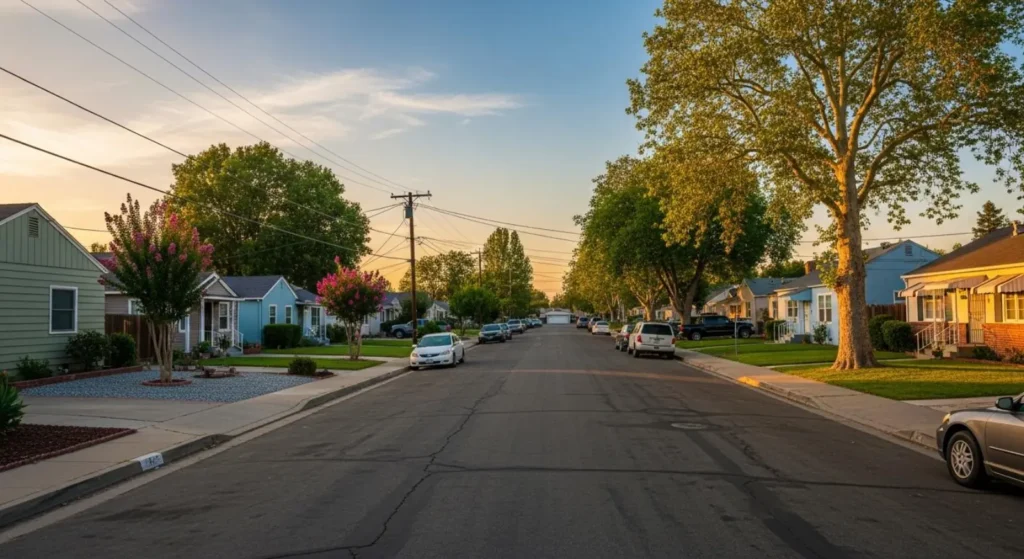
North Highlands sits in the Valley climate zone with hot, dry summers above 100°F and concentrated winter rain. The density of older multifamily stock — much of it now 50+ years old — means flashing fatigue and sealant breakdown have been accumulating across multiple ownership cycles. That cumulative weathering on aging base-era construction is the single biggest reason hidden water damage builds up behind ledger boards on the area's apartment stock.
Issues that repeat across the local building stock — from climate, construction era, or common materials in this area.
Garden apartments built for McClellan personnel along Watt, Don Julio, and Larchmont between the late 1950s and the mid-1970s frequently used face-nailed ledgers with minimal or no flashing detail. Water tracks behind the stucco and rots joist ends from the inside — a condition only a deck safety inspection with moisture probes and targeted board removal will reliably confirm before failure becomes visible from the unit. With most of these buildings now well past 50 years of service, this is the single most common finding in every deck inspection report we deliver in North Highlands.
Topical waterproof membranes on the older 1970s--80s three-story apartment stock along Watt Avenue and Antelope Road are often original — meaning 40+ years in place, well past any manufacturer service window. Blistering, edge lift, full delamination, and drain failure appear in nearly every deck inspection report we deliver on base-era multifamily.
Hot, dry North Highlands summers have expanded and contracted the metal flashing on these complexes thousands of times by now. By the time a deck inspection company is called out on a Don Julio or Antelope Road property, the damage has often been accumulating behind the wall for two or three decades.
Older joist hangers, lag bolts, and cast-in-place post bases on North Highlands' base-era multifamily often fall well short of current CBC load requirements — and on stock this old, the corrosion is usually visible from the ground. A proper deck footing inspection regularly uncovers rusted post bases sitting directly on concrete without standoff, plus undersized hardware. We correct both with code-compliant stainless or hot-dip galvanized hardware on the same project.
A large share of North Highlands apartment balconies were built with 36" guardrails — sometimes lower on the oldest base-era stock — where 42" is now required. We flag these during the walk and raise/reinforce them under the same scope of work rather than splitting the project across two contractors.
SB 721 inspections for North Highlands apartment complexes on the 6-year cycle — across Watt Avenue, Don Julio Boulevard, Antelope Road, Elkhorn Boulevard, and the Larchmont Drive corridor. Tenant access coordination, unit notices, and full written reporting handled end-to-end by one licensed team. This is the dominant scope of work in North Highlands given the depth of the rental apartment market.
SB 326 inspections for the smaller pool of North Highlands condo associations on the 9-year cycle — primarily clustered along the Elkhorn Boulevard corridor and the southern fringe near Madison. Engineer signature included on every letter.
Board-ready reporting, deck permit filings, and a final compliance letter formatted for HOA archives, lender reviews, and insurance carriers. We also provide a clean condo checklist inspection format usable for both compliance filings and reserve-study documentation.
Garden-style apartments, three-story walk-ups, townhomes, fourplexes, and mixed multifamily stock across greater North Highlands and the adjacent Foothill Farms and Antelope corridors.
Serving all of North Highlands with fast response times. Most assessments within 3 business days.
After the work is complete, you walk away with a full archive package — ready for your HOA board, insurer, city, or next property sale.
Before, during, and after photos tagged to every structural element inspected.
Full permit package, inspection card sign-offs, and city correspondence archived.
Manufacturer warranties plus our labor guarantee in writing.
Detailed scope-of-work summary covering every repair and reinforcement.
Engineer-signed SB 721 / SB 326 letter for your HOA archive, insurance, and lender.
For North Highlands projects we also include county permit references and, where relevant, age-of-construction baseline notes on base-era complexes where original construction documents are no longer available — useful for both insurance underwriting and refinance reviews.
We walk the property, identify scope, and flag any urgent safety items. No cost, no obligation.
Full proposal with line-item pricing, material specs, and a realistic timeline.
We handle city permits and coordinate tenant notices with property management.
One licensed crew, start to finish. Daily photo updates and clean worksites.
City sign-off, warranty package, and compliance letter delivered to you.
We own three older complexes off Don Julio and needed SB 721 compliance plus structural repair on hidden rot we already suspected was there. ABD's deck inspection report mapped every problem element across all three buildings — the insurance carrier accepted the repair scope without a single follow-up question.
ABD handled SB 721 across our Watt Avenue complex on a tight timeline. They documented the original base-era construction issues clearly enough that we could justify the full repair budget to ownership — and the engineer-signed letter was filed before our lender review.
North Highlands is an unincorporated community, so permits go through the county Building Permits & Inspection Division rather than a city building department. Structural repairs that replace more than 25% of a deck or balcony assembly require a deck permit. We file the submittal, track the inspection card, and close out the permit as part of every project scope so property owners don't have to chase the paperwork.
The home inspection cost in California for SB 721 work depends on unit count, elevated-element count, and building age. For a typical North Highlands base-era complex along Watt Avenue or Don Julio Boulevard, SB 721 pricing is based on unit count and the depth of the elevated-element inventory — older complexes with multiple breezeways, walkways, and three-story balconies require more on-site time than a single-building scope. We deliver a fixed-price quote after a free on-site assessment — no surprise add-ons.
On base-era North Highlands stock, the honest answer is usually yes. Buildings 50+ years old with original ledger flashing and original membrane systems almost always need structural repair beyond the inspection scope. We document this transparently in the deck inspection report so owners can plan budget realistically — and because we handle both the inspection and the repair work in-house, there are no surprise change orders or finger-pointing between contractors.
In the wrong city? Jump to the right page for your property.
Tell us about your property and we'll come out, walk it, and give you a written plan — free of charge, no obligation.